5 Opportunities & Risks If the Fed Ends QT – Impact on Altcoin Market!
Jakarta, Pintu News – Talk of global monetary policy is back in the spotlight after reports that if the Fed ends quantitative tightening (QT), risky asset markets – including cryptocurrencies and altcoins – could rally. This article discusses how monetary decisions in the US could have far-reaching effects on crypto markets, as well as the supporting factors and risks to be aware of.
1. What is QT and why its end is important
QT (quantitative tightening) is the Fed’s policy of shrinking its asset balance sheet, usually by selling bonds or letting bonds mature without being replaced – this reduces global liquidity. According to reports, if the Fed stops QT, liquidity will increase back into the market.
Looser liquidity tends to encourage capital flows into riskier assets like cryptocurrencies and altcoins – as investors become more willing to take risks than when liquidity is tight. Therefore, the decision to end QT is considered a potential positive catalyst for the crypto market.
Also Read: 3 Stock Sectors Predicted to be Bought by Investors as the Technology Sector Weakens
2. Impact on altcoins – post-QT rally opportunities
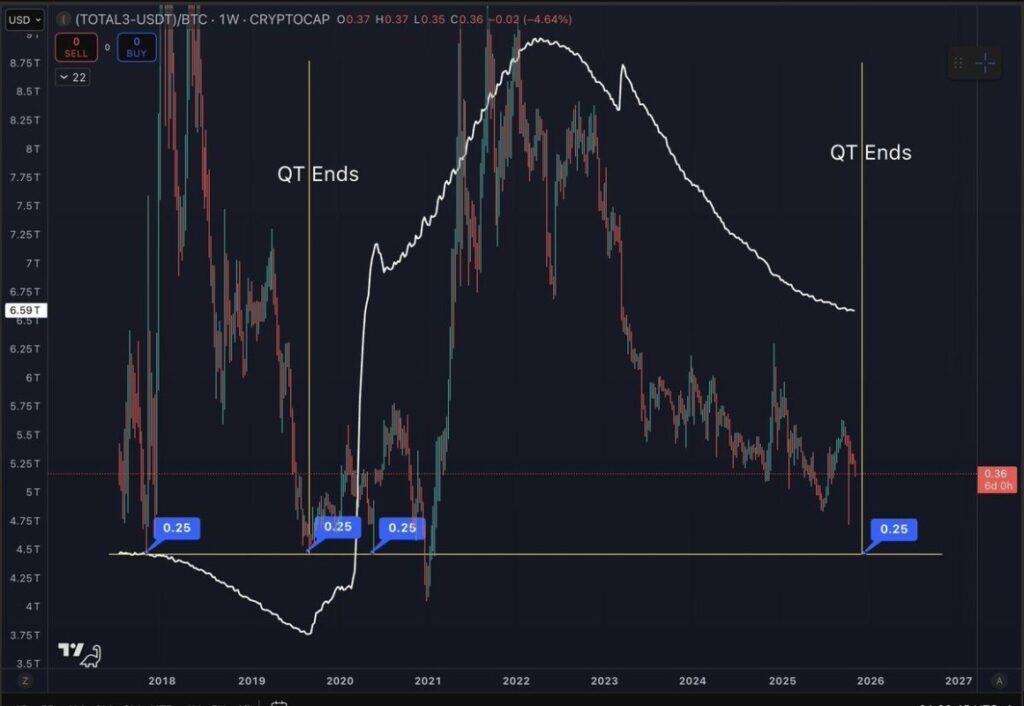
With the return of global liquidity, altcoins could see new capital flows, especially from institutional investors or “smart money” that previously held back. According to analysis at BeinCrypto, the combination of improved liquidity and interest in risky assets could see altcoins take off.
In this context, some altcoins are considered “resilient altcoins” that are poised to benefit from capital rotation – especially altcoins with real utility or projects with strong fundamentals that the market is “monitoring”.
3. Additional driving factors – low yields and risk assets
If QT is stopped, bond yields and fixed income assets may remain low – this makes risky assets such as stocks and cryptocurrencies relatively more attractive. Based on analysis, in conditions of low yields and cheap capital costs, investors tend to seek returns in risky assets, so altcoins can be “hunted” again.
Cheap liquidity and low yields from bonds could encourage the flow of funds into cryptocurrencies, supporting the chances of a rally that deserves to be called “eye-catching”.
4. Risks and conditions to be considered
Despite the opportunity to rise, altcoins still face risks from global market volatility and interest rate expectations. If global inflation spikes again or macro conditions worsen, the Fed could reconsider monetary policy – meaning a potential rally could be canceled out.
Additionally, the crypto market could be vulnerable to a sharp correction if the anticipation of the end of QT is already “reflected” in prices – meaning that many expectations have already been bought by the market (“priced in”), so the realization of the end of QT does not have a big impact.
5. What it means for investors and crypto market participants today
For medium-to-long term investors, the end of QT could be a moment to re-evaluate portfolios – especially altcoins that have clear utility and strong project fundamentals. As liquidity and risk sentiment can change quickly, important metrics such as volume, market capitalization, and fundamental adoption should be constantly monitored.
However, it is important to remember that monetary decisions are only one of many factors – regulation, market cycles, and macro conditions still play a crucial role. Hence, strategies should be flexible and data-driven.
FAQ
What is QT and why is its expiration relevant for crypto?
QT is the Fed’s balance sheet shrinkage policy – ending QT could add to global liquidity, which could boost risky assets like cryptocurrencies.
How can altcoins benefit if QT is discontinued?
Increased liquidity and low yields have investors seeking returns in riskier assets – altcoins with strong fundamentals could attract new funds.
Is an altcoin rally guaranteed after QT ends?
No – because many other factors come into play, including inflation, regulation, and global market conditions.
What risks should we be aware of even if QT ends?
Global volatility, interest rate expectations, and that positive effects could be priced in.
What is the best strategy for crypto investors now?
Monitor important metrics such as liquidity, project adoption, and macro conditions – and not rely on just one catalyst (such as QT) to make decisions.
Reference
- BeinCrypto. Fed QT End May Trigger Altcoin Rally. Accessed on December 2, 2025