5 Strategies for Investors in a Bear Market
A bear market is an inevitable phase of price decline in the crypto market cycle. For many investors, it triggers panic and decisions that can be costly. However, experienced investors see it as an opportunity. Here are 5 strategies you must have to survive and even thrive in a bear market.
Article Summary
- 🐻 Definition of Bear Market: A bear market is a phase of significant decline in asset prices, generally more than 20% from their peak and lasting for a relatively long period accompanied by negative sentiment in the market.
- 📈 Bull and Bear Market Cycles: In the crypto market, the bear market always comes after the BTC price prints a new high, after which the bear market lasts about 1-2 years.
- 🛠️ 5 Strategies in a Bear Market: Investors can apply several methods, including being patient in determining assets and purchase price targets, prioritizing capital protection, conducting stricter asset selection, deepening skills and analysis, and utilizing strategies such as short selling.
What is a Bear Market?
A bear market is a market condition where the price of an asset drops significantly, generally by more than 20% from its peak and lasts for a relatively long period. In the crypto market, the decline can be much deeper, even reaching 70-90% of the all time high , as happened to Bitcoin in 2018 and 2021.
Different from short-term corrections, bear markets usually last months to over a year, accompanied by widespread negative sentiment, declining trading volumes, and fear dominating the market.
In general, bear markets usually occur after an asset prints an ATH which is then followed by a market correction that is considered natural because it has experienced a long rally. Selling pressure is then amplified by other factors such as macroeconomic conditions, monetary policy, or geopolitical tensions. These conditions can also trigger sharp and unpredictable price declines and exacerbate market panic.
Market Cycles and their Relation to Bear Markets
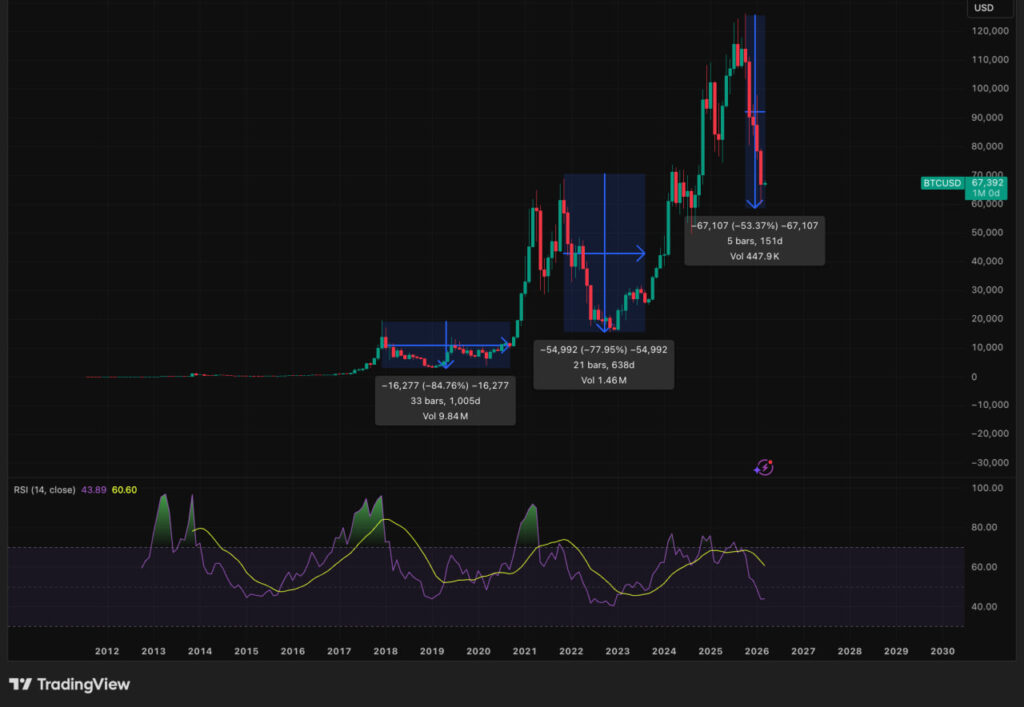
This cycle centers on the bitcoin halving event, which reduces the rewards received by Bitcoin miners by 50% every four years.
Looking at historical data, Bitcoin tends to print a new ATH within 12-18 months of a halving. This makes the halving one of the strongest catalysts that triggers the bull market phase and indirectly, also marks the start of the next bear market after the euphoria subsides.
| Bitcoin Halving | Post Halving ATH Price | Halving Duration → ATH | Bear Market Phase Post ATH |
| November 2012 | $1,160 (November 2013) | 368 days (~12 months) | December 2013 to January 2015. Lowest price: $152 (-86% of ATH) |
| July 2016 | $19,666 (December 2017) | 525 days (~17 months) | January 2018 to December 2018. Lowest price: $3,122 (-83% of ATH) |
| May 2020 | $69,000 (November 2021) | 549 days (~18 months) | December 2021 to November 2022. Lowest price: $15,478 (-78% of ATH) |
| April 2024 | $126,200 (October 2025) | 534 days (~17 months) | November 2025 to February 2026. Lowest price: $59,900 (-53% of ATH) – ongoing |
Based on the data in the table above, the historical pattern shows that each halving period is generally followed by a bull market phase which then ends in a bear market. Although the duration and intensity differ, the cyclical structure is relatively repetitive.
Historically, the correction of ATH during bear market phases can even reach more than -80%, as seen in some previous cycles. This emphasizes the high volatility of Bitcoin compared to traditional assets.
A new ATH tends to form about 2 to 3 years after Bitcoin reaches the low point of the previous cycle. During this time, the market usually undergoes a consolidation phase or sideways movement, which is often utilized by long-term investors to accumulate.
However, not all patterns repeat identically. Each cycle is influenced by various conditions such as macroeconomics, global liquidity, and different market dynamics.
5 Bear Market Strategies
Here are some relevant strategies to adopt in a bear market:
1. Patience in Determining Assets and Target Buy Price

When prices drop by more than 20%, most investors new to crypto immediately experience panic and sell all their assets. This decision is often made based on emotions that trigger capitulation and lack of a well-thought-out strategy in dealing with falling asset prices and often becomes regrettable when the market re-enters the bull market phase.
Investors who have experience and have been through several bear market phases often have a different perspective on these declines.
Things that can be done:
- Create a watchlist of assets that you believe in the fundamentals. Do this during market downturns as well as in calm phases. See how their price movements respond to Bitcoin’s price decline. Assets that are able to hold up relatively better than Bitcoin during market downturns are usually attractive accumulation candidates.
- Set a target buy price based on the analysis you’ve made. One approach is to identify historical support areas as buy zones for the asset, so that the buy decision is already planned before the price actually gets there.
2. Capital Protection
The main priority in a bear market is to preserve capital and make decisions that are driven by the bias that an asset’s decline is the lowest price point and therefore allocates all the capital in 1 transaction.
The most proven strategy for long-term investors in this environment is Dollar Cost Averaging or DCA, which involves regularly buying a fixed amount of an asset, regardless of the current market price.
Simulation of DCA vs. Buy All at Once in the 2022 Bear Market:
Suppose an investor has Rp12 million in capital in early 2022 and wants to allocate it to Bitcoin.
- Investor A (All In)
Invested the entire IDR12 million at once when the price of BTC was around $47,000. When the price dropped significantly until the end of 2022, the value of his portfolio shrank to about Rp3.9 million, or a decline of about 67%.
- Investor B (DCA)
Allocating Rp1 million per month for 12 months. With this strategy, his average purchase price is around $28,000. As a result, the decline in his portfolio value is relatively more manageable, and he accumulates more BTC for a potential recovery in the next cycle.
Both suffered unrealized losses. However, the DCA strategy makes Investor B’s position more optimal when the market enters a recovery phase. With this approach, Investor B also doesn’t speculatively guess the lowest price point.
Basic rules of risk management in bear markets:
- Invest only money that is not needed for at least the next 1-2 years.
- Keep an emergency fund of at least 6-9 months of expenses outside of crypto.
- Diversification of assets or investment instruments is an important step to manage risk. Investors can spread their capital across multiple asset classes, such as crypto and stock tokenization, to improve portfolio balance.
Learn more about stock tokenization so you can choose the right instrument: What is Tokenized Stock? Complete Guide to Digital Stock Investing - Pintu Academy
3. Focus on Asset Fundamentals
Bear markets often expose the weaknesses of crypto projects that lack strong fundamentals. Many tokens that looked promising during the bull market phase turned out to be driven by sentiment and speculation, so when they entered the bear market, their prices never really recovered.
Under these conditions, investors need to be able to distinguish between “cheap prices” and assets that have strong fundamental value. A low asset price does not necessarily reflect the quality of the asset, as the asset still has the potential to fall further. In contrast, assets with strong fundamentals are underpinned by clear usability, active development, and widespread adoption, allowing them to grow again when the market cycle reverses.
Thus, the bear market is not only a selection phase for investors with high mental resilience and discipline, but also serves as a natural selection for crypto projects.
That’s why in bear markets, Bitcoin has historically been a top accumulation priority for investors. As the asset with the highest liquidity, largest institutional adoption, and a proven track record of recovery in every cycle, Bitcoin is the most proven asset to come out of a bear market and print a new ATH in recent cycles.
Characteristics of Projects with Strong Fundamentals:
- Team and Transparency
Is the development team clearly identified and has a credible track record? Are they still actively developing the product despite the token price decline? The transparency of communication and the accuracy of project development execution in the roadmap are important indicators in assessing the long-term commitment of the project.
- Network Activity and Adoption
What is the level of on-chain activity, number of active users, and transaction volume? Does the project have a clear utility that keeps it in use despite the market downturn?
- Tokenomics
What is the token distribution structure? Are there a large number of unlocks scheduled in the near future that could potentially increase selling pressure? A balanced supply and incentive mechanism determines the long-term sustainability of the token value.
Historically, many altcoins that have experienced a decline of more than 90% in the bear market phase have never returned to their highest price. Therefore, in-depth research(Do Your Own Research/DYOR) is an important step before making investment decisions. In addition, asset accumulation should be done selectively and proportionally to avoid the risk of overexposure to high-risk assets.
4. Sharpen Skills and Analysis
If a bull market is a phase to “harvest” the results of previous accumulation, then a bear market is an ideal momentum to build skills and deepen analysis. This phase provides room to learn without the pressure of market euphoria.
Investing in competency development during bear markets often yields greater and more sustainable benefits than simply buying assets at bargain prices.
Traders or investors who enter the next bull market with a more mature understanding of market dynamics are likely to be able to make more rational, measured and disciplined decisions than before.
Things to learn:
- Technical Analysis
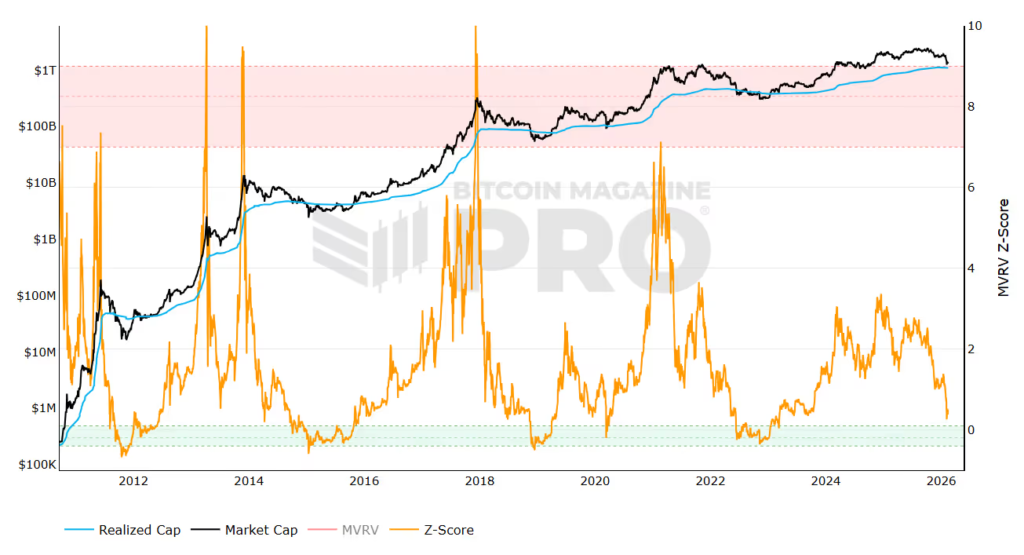
Learn technical analysis which can include market indicators, structure, patterns and psychology. Also deepen your understanding of on-chain metrics such as MVRV Z-Score to identify undervaluation and overvaluation zones, and Hash Ribbons to monitor the state of miner profitability to signal a potential market recovery. These two metrics have historically preceded major recoveries in every Bitcoin cycle. Commonly used platforms include Bitcoin Magazine Pro, Glassnode or CryptoQuant.
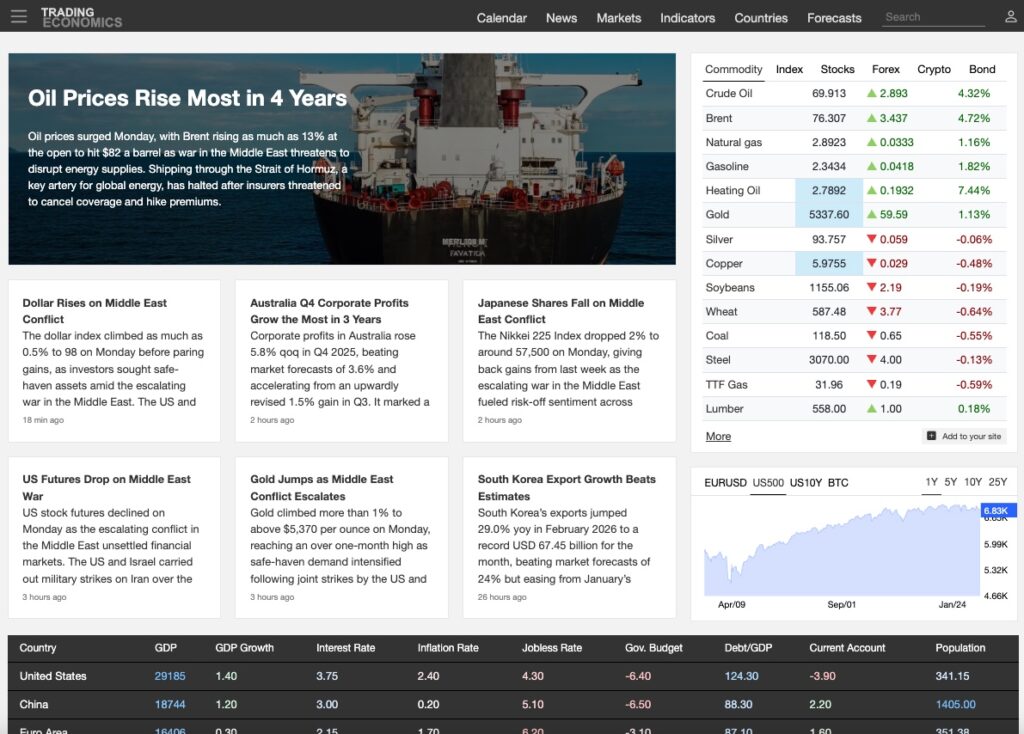
In addition to studying asset fundamentals such as whitepapers, usability, tokenomics and others, learn how macroeconomic factors such as interest rate policy, inflation and global liquidity can relate to crypto market movements. Fundamental analysis helps you assess asset quality, while macro understanding helps you determine the right timing.
5. Short Selling
In a bear market, there is a strategy that allows traders to potentially make a profit even when prices are falling, that’s short selling. Unlike the buying and selling process in the spot market, short selling is a trading activity that can involve leverage and opening short positions against Futures contracts, meaning that when prices fall you can make a profit.
When is short selling effectively utilized?
Short selling is most effective under two conditions:
- When the downtrend is technically confirmed.
- When there is a relief rally, which is a temporary price increase in the middle of a bear market that can be utilized as an entry point for short positions before prices resume falling.
Short Selling as a hedging strategy
Apart from being used to take advantage of falling prices, short selling can also be utilized as a hedging strategy, which is a strategy to protect the value of the portfolio you already own without having to sell the asset.
For example, let’s say you have 1 BTC in the spot market and don’t want to sell it, but you’re worried that the price will still drop in the near future. In this situation, you could open a partial short position in futures as protection:
- If the price falls, profits from short positions offset temporary losses in the spot portfolio
- If the price rises, it’s your spot portfolio that benefits, while the short position can be closed with a calculated loss as part of risk management.
Hedging strategies require a precise entry process, learn more about effective hedging strategies at Pintu Academy.
Trading Futures on Pintu Pro Web
After knowing the various strategies in bear market, you can open short positions such as BTC, SOL, and others directly through Pintu Pro Web. On Pintu Pro Web, you can trade Futures and spot right away!
How to trade Crypto Futures on Pintu Pro Web:
- Go to https://pintu.co.id/
- Click the Open Pro on Desktop button at the top center.
- Register or log in to Pintu Pro Web.
- Go to the Futures section.
- Trade BTC and other cryptocurrencies.
In addition to trading, Pintu also lets you learn more about crypto through various articles on Pintu Academy, updated weekly!
Disclaimer: All information presented in this article has been prepared for general educational and informational purposes. This content is not intended as investment advice, recommendations, solicitation to buy or sell certain crypto assets, nor the basis for financial decision making. Any investment decision is entirely the responsibility of the reader, taking into account their financial condition, investment objectives, and risk tolerance.
Conclusion
Bear markets are an unavoidable phase in the market cycle, and it is during this period that investors’ understanding and mental resilience are truly tested. The main priority in dealing with this phase is not to pursue profits, but to preserve capital and manage risks in a disciplined manner so that investors or traders can survive and get through this phase.
Reference
- OxKira, “Trading Strategies for a Bear Market“, Arkham, accessed on February 25, 2026.
- Dan Mitchell, “How to trade in a bear market: CFD trading strategies“, capital.com, accessed on February 25, 2026.
- Pam Claasen, “How to trade in a bear market“, IG.com, accessed on February 25, 2026.
Share
Related Article


See Assets in This Article
ATH Price (24 Hours)
Market Capitalization
-
Global Volume (24 Hours)
-
Circulating Supply
-

