What is Insider Trading in Crypto?

In the world of finance, information is the most valuable currency. However, when that information is used unfairly before it becomes public knowledge, a practice known as insider trading emerges. In the fast-paced and often less regulated crypto market than the stock market, this practice poses a major challenge to market integrity. In this article we will understand what insider trading in crypto is, how it works, examples, and strategies to avoid it.
Article Summary
- 🕵️ What is Insider Trading: Crypto transactions using important information that has not been made public, such as listing plans or strategic partnerships.
- ⚖️ Why Banned: This practice undermines market fairness, price integrity, and investor confidence.
- 🏛️ Real Cases: The Coinbase and OpenSea cases prove that misuse of internal information can lead to criminal charges.
- 🔍 How it works: The trader buys the asset before the official announcement and then sells it when the price spikes.
- 🛡️ How to Avoid: Use public data, avoid internal leaks, and adhere to ethical investment standards.
What is Insider Trading in Crypto?
Insider Trading is the illegal or unethical practice of buying or selling crypto assets based on material non-public information.
“Material” information is information that, if made public, is likely to significantly affect the price of an asset. In a crypto context, this information could be:
- Plans to list the new coin on a major exchange (such as Binance or Coinbase).
- Strategic partnerships with tech giants.
- Major protocol updates or hard forks.
- A large investment from a venture capital (VC) that has yet to be announced.
Unlike traditional capital markets where rules are well-established (such as under the SEC in the US), in the crypto world, these boundaries are often blurred due to the decentralized nature and anonymity of digitalwallets.
Why Insider Trading is Banned?
Here is a detailed explanation of why this practice is prohibited, supported by the latest data and regulations up to 2026:
1. Principle of Level Playing Field (Equal Access)
A healthy capital market relies on the principle that all investors have equal access to material information (information that can affect share prices).
- Information Inequality: When “insiders” trade based on information that has not been made public, they steal profits from the ignorant public investors.
- Impact Data: Based on a capital markets study (2024-2025), markets with weak enforcement of insider trading laws tend to have a highercost of capital as investors demand a larger risk premium to cover the possibility of them being cheated.
2. Maintain Integrity and Public Trust
If investors feel the market is being “manipulated” by a handful of elites, they will withdraw their capital.
- Domino Effect: A decrease in retail investor participation will reduce market liquidity. Without liquidity, companies will find it difficult to raise funds through the exchanges.
- Context 2026: With the increasing number of retail investors in Indonesia (over a dozen million), OJK and the Indonesia Stock Exchange (IDX) are tightening supervision as one major insider trading case could trigger mass capital outflows.
3. Breach ofFiduciary Duty
Directors, commissioners or employees of the company have a moral and legal responsibility to prioritize the interests of shareholders, not personal pockets. Using confidential company information for personal gain is considered a betrayal of the shareholders’ trust.
Crypto Insider Trading Example
The crypto world has witnessed several high-profile cases that have even led to criminal legal action:
1. Ishan Wahi Case (Coinbase)
This case is a milestone as it is the first crypto insider trading case to be formally prosecuted by the US Department of Justice (DOJ) and the Securities and Exchange Commission (SEC).
Chronology and Modus Operandi
Ishan Wahi is a former product manager at Coinbase, one of the largest crypto exchanges in the world. In his role, Ishan had exclusive access to information about which digital assets would soon belisted on the exchange.
- Action: Between June 2021 and April 2022, Ishan leaked the listing schedule to his brother, Nikhil Wahi, and friend, Sameer Ramani.
- Mechanism: Given that the price of crypto assets usually spikes dramatically immediately after a listing announcement on Coinbase (a phenomenon known as the “Coinbase Effect”), the gang purchased the assets on a decentralized exchange (DEX) a few hours before the official announcement.
- Profits: They made at least $1.5 million in illegal profits from trading at least 25 different cryptocurrencies.
Legal and Academic Impact
Academically, the case is interesting because the SEC classified at least 9 of those crypto assets as “securities”, although Coinbase disputes that.
- Verdict: Ishan Wahi was sentenced to 2 years in prison in mid-2023. This case confirms that corporate confidentiality is a property asset that should not be misused for personal gain.
2. Nathaniel Chastain Case (OpenSea)
This case proves that the law does not only target cryptocurrencies, but also unique digital assets such as NFTs(Non-Fungible Tokens).
Case Details
Nathaniel Chastain is the former Head of Product at OpenSea, the largest NFT marketplace. He was responsible for choosing which NFTs to feature on the site’sfront page.
- Manipulation: Chastain bought NFTs in secret shortly before they were put on the front page, then resold them at double the price after their popularity soared due to exposure on the main page.
- Legal Challenges: Chastain’s lawyers argued that NFTs are not securities or commodities, so traditional insider trading laws do not apply.
Legal Significance:Misappropriation Theory
The prosecution used the theory of “Wire Fraud” (fraud by electronic means). The court found Chastain guilty of misusing confidential information belonging to the company (OpenSea) for personal gain, regardless of whether the NFTs were categorized as securities or not. Chastain was sentenced to imprisonment and a fine by the end of 2023.
3. Polymarket Insider Trading Rumors
Unlike a regular crypto exchange, Polymarket is a prediction market. The insider trading rumors here are not about “what coin will go up,” but rather “what world events will happen.”
The following is an explanation of the rumors and cases of insider trading indications in Polymarket:
FBI Investigation of Shayne Coplan (November 2024)
While it’s not always individual insider trading, Polymarket CEO Shayne Coplan has had his home raided by the FBI.
- Key Issues: The US Department of Justice (DOJ) is investigating whether Polymarket let users from the US bet (in violation of a previous agreement with the CFTC).
- Rumors of Manipulation: In addition to access issues, there have been allegations of wash trading (pseudo-trading to manipulate volume) during the 2024 US presidential election period to give the impression that one candidate is superior to the other in order to influence public perception.
Rumored Airstrikes on Iran (March 2026)
Recently (March 2026), there have been strong allegations regarding the use of intelligence information in war betting.
- Anomalies: An account called “MAGA my man” placed a large bet exactly 71 minutes before the first airstrike took place in Iran.
- Suspicious Volume: Total bets on this event reached hundreds of millions of dollars in a short period of time before official news broke in the mass media. Many suspected that individuals with access to the Situation Room or intelligence devices were using Polymarket to “cash in” on their confidential information.
Case of Military Operation against Maduro (January 2026)
One of the most heated rumors occurred in early 2026. A mysterious trader with the account name “Burdensome-Mix” placed a $32,000 bet that Venezuelan President Nicolás Maduro would be overthrown or arrested before the end of January.
- Awkwardness: This bet was placed just hours before former US President announced a military operation order.
- Results: The account made a profit of more than $400,000. This sparked suspicions that an “insider” in the government or military leaked the operation plan to the prediction market.
How Insider Trading Works
Insider trading in crypto usually follows a systematic pattern. Here are the general stages:
1. Acquisition of Material Non-Public Information (MNPI)
The initial stage begins when certain individuals (such as project developers, stock exchange teams, or strategic consultants) gain access to Material Non-Public Information (MNPI). In the crypto context, this information is usually:
- Planned listing on a major exchange (Tier-1 Exchange).
- Strategic partnerships with tech giants.
- Significant protocol or token burn mechanism updates.
2. Strategic Accumulation (Front-running)
Before the information is made public, the perpetrator manipulates the market position through Strategic Accumulation. To avoid detection by exchange surveillance systems or on-chain trackers:
- Wallet Diversification: Perpetrators use a distributed network of anonymous wallets (not centralized to a single entity).
- Front-running: Buying large volumes of an asset while the price is still at a base level (consolidation), thus creating “invisible” buying pressure.
3. Public Catalyst & Multiplier Effect
Shortly after the accumulation is complete, information is officially released. This announcement serves as a Market Catalyst. At this point, a mass psychology phenomenon occurs:
- FOMO (Fear of Missing Out): Retail investors who have just received information will react impulsively.
- Demand Surge: Massive capital inflows over a short period of time, triggering exponential price appreciation (often referred to as a pump).
4. Sell and Seek Exit Liquidity
At the peak stage of volatility, “insiders” engage in systematic asset divestment or selling.
- Profit Realization: Participants sold their assets at the highest prices driven by retail euphoria.
- Exit Liquidity: Newly-entrant retail investors unwittingly act as liquidity providers for insider traders. Once the distribution process is complete, prices often experience a sharp correction or crash due to the loss of internal buying pressure.
Impact of Insider Trading
Many consider insider trading to be a matter of “first come, first served”. In fact, the practice is far more damaging than just stealing a head start. It is a form of systemic injustice that harms the investment ecosystem as a whole. Here are 4 key impacts that we need to understand:
1. Retail Investors Become the “Victim” (Exit Liquidity)
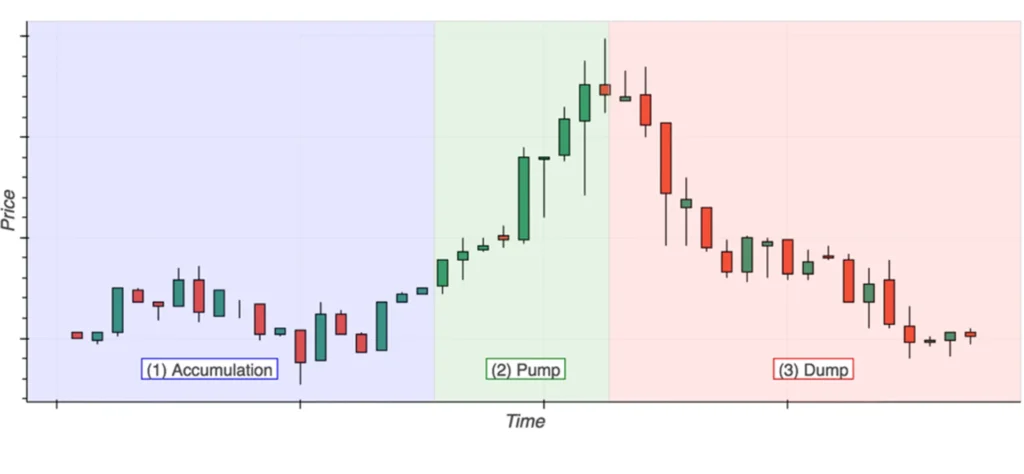
In the investment world, there is such a thing as exit liquidity-that is, aparty who buys an asset at the peak of its price, so that the other party can sell and make a profit.
- The scenario: Imagine that a company officer knows that his company will fail the audit. Before the news is announced, he sells all his shares.
- Impact: Clueless retail investors see prices still stabilizing and continue to buy. As soon as bad news is released, prices plummet, and retailers are stuck holding assets whose value is destroyed. Here, retailers are no longer investing, but becoming “donors” to insider profits.
2. Breakdown of “Price Discovery”
Ideally, the price of an asset rises or falls due to company performance or the organic laws of supply and demand.
- Value Manipulation: When insider trading occurs, the price moves because of leaked confidential information, not because of the asset’s true value.
- Effect: Fundamental analysis (reading financial statements) or technical analysis (looking at charts) becomes irrelevant. The market becomes logically unpredictable because there are “invisible hands” moving prices from behind the scenes.
3. Crisis of Confidence: The Market Feels Like a Casino
Investing is different from gambling because of transparency. However, if insider practices are allowed, the market loses its integrity.
- Psychological Effect: Investors will feel that the market is “rigged“. If the public feels they will never win against insiders, they will withdraw their money and leave the market.
- The Market Is Deserted: Without the participation of the general public, the market will lose liquidity. This means that it will be difficult for anyone to buy or sell assets at a fair price as there are fewer active players.
4. Hindering the Entry of “Big Money” (Institutions) 5.
Large investors such as pension funds or global financial institutions strongly avoid markets that are considered “wild” and lack strong legal protection.
- Compliance Standards: Institutions have strict auditing standards. If an exchange or asset market (such as crypto) is notorious for insiders, they will not venture in due to legal and reputational risks.
- Stagnation: Without the support of institutional investors, it is difficult for an investment ecosystem to mature and stabilize.
Bottom line: Insider trading creates inequality in the capital market. Investment success should be based on analytical skills, not on access to confidential insider information. If this practice is allowed, the function of investment as a driver of economic growth will shift to a means of exploitation of public wealth.
Insider Trading Avoidance Strategy for Investors
To keep your portfolio clean and avoid legal or ethical issues, apply the following principles:
Rely on On-Chain Data, Not “Insider” Rumors
Crypto has the advantage of transparency that traditional stock markets lack: Blockchain. Instead of looking for leaks in secret Telegram groups, use on-chain analysis tools (such as Nansen, Dune Analytics, or Arkham Intelligence).
- Analysis: If you see awhale moving, it is public data available to anyone who wants to look. Acting on this public data does not constitute insider trading.
Avoid “Alpha” Groups that Promise Exclusive Leaks
Many paid groups claim to have access to the development team. If you get information that “Coin X will be listed on exchange Y tomorrow at 10am” before there is an official announcement, and you act on that information, you are in a legal danger zone.
- Suggestion: If the information feels too specific and isn’t already on the project’s official social media, think of it as MNPI.
Adhere to the “Silent Period” Policy
If you work for a crypto project, are an advisor, or have a close relationship with the development team, you should understand the concept of Quiet Period or Silent Period.
- Do not trade your own project assets at least 2-4 weeks before a major announcement.
- Use lock-up policies or automated selling schedules through smart contracts to prove that your buy/sell decisions are not based on breaking news.
Building a Personal “Wall of Ethics”
Avoiding insider trading is about building a long-term reputation. In a decentralized economy, trust is the most valuable currency.
- Educate Yourself: Understand that in many countries, wire fraud laws are often used to prosecute crypto insiders, despite the lack of crypto-specific rules.
- Research-based Diversification: Don’t get hung up on that one “magic coin” you heard about from a friend who works at a related company.
- Transparency: If you are a content creator or influencer, alwaysdisclose your asset ownership position(disclosure) before discussing a project.
How to Recognize the Characteristics of Insider Trading
Although done clandestinely, these practices usually leave a mark on trading activity. Here are some indicators to look out for:
1. Trading Volume Anomalies
A sudden significant spike in transaction volume without any underlying market sentiment or official announcement. If “big money” is moving in massively in a stealthy manner, it should be suspected as a steal start.
2. Price Movement Before the Official Announcement
Be aware of situations where asset prices spike or fall sharply a few days before big news is released. This phenomenon indicates an information leak that is exploited by certain parties before the public is aware of the news.
3. Unusual Wallet Activity (On-Chain Analysis)
In the crypto ecosystem, blockchain transparency allows us to monitor the activity of certain wallets. Large token purchases by new wallets right before they arelisted on major exchanges are often a strong indication of internal information access.
4. Aggressive “Sell on News” Phenomenon
Sometimes, when positive news is finally released, the price falls with very high selling volume. This indicates that insiders who have bought at the lower price start to take profits by capitalizing on the enthusiasm of public investors who have just received the news.
Indonesia’s Crypto Insider Trading Regulation
In Indonesia, crypto is categorized as a Crypto Asset that falls under the realm of commodities. The following is the regulatory basis:
- Authority of Bappebti: Currently, crypto trading is supervised by Bappebti (Commodity Futures Trading Supervisory Agency) under the Ministry of Trade.
- Bappebti Regulation No. 8 of 2021: Article 52 explicitly prohibits any form of market manipulation, including the use of inside information for personal or group gain on futures/crypto exchanges.
- P2SK Law (Financial Sector Development and Strengthening): The Indonesian government has strengthened its legal “fangs” through Law No. 4 of 2023 on Financial Sector Development and Strengthening (P2SK Law) which improves the old Capital Market Law (No. 8 of 1995).
| Aspects | New Provisions (P2SK Law & POJK) |
|---|---|
| Definition of “Insider” | Expanded not only to directors/commissioners, but also parties who have constructive knowledge. |
| Criminal Sanctions | Maximum imprisonment of 10 years. |
| Penalty Sanctions | Maximum IDR 25 Billion (may increase if the loss incurred is greater). |
| Authority of OJK | OJK now has broader investigative powers, including confiscating the proceeds of crime before a court decision. |
Conclusion
Insider trading is a serious threat to the integrity of crypto markets. While blockchain technology offers a high level of transparency, the anonymity within the ecosystem is often abused to gain unfair advantage. The practice of insider trading is prohibited because it is essentially a form of misuse of material non-public information for personal gain. The impact not only undermines market transparency, but also harms retail investors and disrupts the efficiency of the price formation mechanism. As the development of digital systems becomes more sophisticated in 2026, the perpetrators’ room for maneuver becomes increasingly limited because traces of digital transactions are much easier to trace and difficult to eliminate.
Disclaimer: All articles from Pintu Academy are intended for educational purposes and do not constitute financial advice.
Reference:
- GoTrade. Insider Trading: Meaning, Types, Examples, and Impact. Accessed March 22, 2026
- Investopedia. What Is Insider Trading and When Is It Legal?. Accessed March 22, 2026
Share
Table of contents
Related Article
See Assets in This Article
Official Trump Price (24 Hours)
Market Capitalization
-
Global Volume (24 Hours)
-
Circulating Supply
-

