What is Force Majeure and Examples? A Complete Guide to Protecting Business Contracts
Jakarta, Pintu News – In the world of business and contract law, risk is inevitable. Out-of-control events such as pandemics, earthquakes, or geopolitical conflicts can make it impossible to fulfill contractual obligations. This is where force majeure plays an important role as a form of legal protection that can save businesses from unrealistic liability.
Force majeure is a clause in a contract that relieves one or both parties from legal liability when an extraordinary and unforeseen event occurs that prevents the performance of obligations. But, what is its actual application? And what are the conditions? Check out the following review.
What is Force Majeure?
Force majeure comes from French which means “greater force”. In the context of contract law, force majeure in an agreement is a provision stipulating that a party to a contract will not be considered in default if it fails to fulfill its obligations due to an unpredictable and uncontrollable event.
In order to be considered a force majeure in contract, an event must meet three main criteria:
- Not foreseeable
- Occurring beyond the control of the parties
- Inevitably, even with maximum effort
Also Read: The Potential Price of Shiba Inu If Half the Supply is Burned: SHIB Likely to Surge?
Common Force Majeure Examples
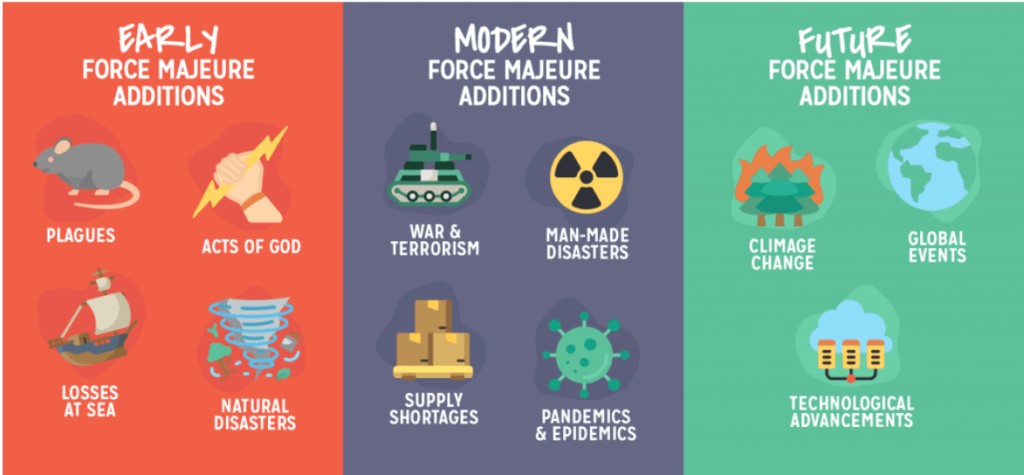
Examples of force majeure that are often included in contracts include:
- Natural disasters such as earthquakes, tsunamis, major floods
- Pandemics or global disease outbreaks (e.g. COVID-19)
- War, coup, or civil unrest
- Government policies such as embargoes or export bans
- Mass power outage or nationwide cyberattack
For example, in a procurement contract, if delivery is delayed because the producer’s region is hit by a major earthquake, the seller can activate the force majeure clause to be exempted from late fees.
Force Majeure Article in Contract: Why should it exist?
The force majeure clause should be written clearly and in detail in the contract. It generally includes:
- List of events considered as force majeure
- Notification procedures when force majeure occurs
- Delay tolerance time limit
- Option to postpone or cancel the contract
Without this clause, a company may still be in breach of contract even if it has been affected by a major disaster. Therefore, force majeure in agreements is essential as a legal and business risk mitigation mechanism.
Force Majeure vs Pacta Sunt Servanda: Which One Applies?
In contract law, there is the principle of pacta sunt servanda which means “agreements must be kept”. However, this principle can be overridden when force majeure occurs. This means that if an extraordinary event actually makes performance of the contract impossible, then the obligation can be canceled without being considered unlawful.
For example, force majeure in trading can arise when exchanges are closed due to global system disruptions or state emergency policies, so traders cannot execute orders according to the contract.
Force Majeure is not an arbitrary reason
It is important to understand that not all events can necessarily be considered force majeure. The claiming party must prove that:
- These events are indeed included in the contract
- The event makes the performance of the obligation impossible (not just difficult)
- Maximum efforts have been made to continue to fulfill obligations
Therefore, consultation with legal experts or in-house legal is highly recommended in determining the validity of force majeure claims.
Conclusion
Force majeure is an important tool for managing risk in business agreements. By including a specific and measurable force majeure clause, companies can protect themselves from potential claims when a truly unexpected emergency occurs.
From force majeure in business contracts to force majeure in trading, a good understanding of these clauses will help you draft agreements that are robust and adaptive to unexpected situations.
Also Read: Can XRP Reach $10 Before 2025 Ends? Investors Should Know This Analyst’s Assessment!
Follow us on Google News to get the latest information about the world of crypto and blockchain technology. Check today‘ s bitcoin price, today’s solana price, pepe coin and other crypto asset prices through Pintu Market.
Enjoy an easy and secure crypto trading experience by downloading Pintu crypto app via Google Play Store or App Store now. Also, get a web trading experience with various advanced trading tools such as pro charting, various types of order types, and portfolio tracker only at Pintu Pro.
*Disclaimer
This content aims to enrich readers’ information. Pintu collects this information from various relevant sources and is not influenced by outside parties. Note that an asset’s past performance does not determine its projected future performance. Crypto trading activities are subject to high risk and volatility, always do your own research and use cold hard cash before investing. All activities of buying andselling Bitcoin and other crypto asset investments are the responsibility of the reader.
Reference:
- Investopedia. Force Majeure. Accessed on October 21, 2025