5 Bitcoin Layer-2 Solutions Ready to Rule the Crypto Industry by 2026

Jakarta, Pintu News – The development of the Bitcoin ecosystem demonstrates the urgent need for solutions capable of increasing transaction capacity without changing its underlying structure. With limited speed at the primary layer and increasing costs during high demand, Bitcoin requires additional infrastructure to support real-time usage.
Layer-2 solutions have emerged to process off-chain transactions while still utilizing Bitcoin’s security. These innovations open up new spaces for cryptocurrencies, from fast payments to smart contracts and asset tokenization.
Lightning Network: Driving High-Speed Bitcoin Payments
Lightning Network is becoming one of the most mature Layer-2 solutions and has gained huge adoption in the crypto ecosystem. It utilizes off-chain payment channels to perform transactions instantly, while the final settlement process remains on the Bitcoin blockchain.
Since transactions do not need to be confirmed on-chain one by one, fees are very low and processing time is almost instantaneous. This model significantly reduces the barriers to using Bitcoin in everyday transactions.

The Lightning network is now widely used by digital wallet providers, trading platforms, and cross-border payment applications. With the ability to process micro-transactions-which were previously uneconomical on the main network-Lightning expands the range of uses for Bitcoin in retail and digital activities.
As global adoption expands, Lightning is becoming a critical component of Bitcoin-based payment infrastructure. This technology emphasizes Bitcoin’s transition from a mere store of value to a modern instrument of exchange.
Stacks: The Bridge between Bitcoin and Decentralized Application Ecosystems
Stacks brings smart contract functionality and decentralized applications (dApps) to the Bitcoin ecosystem without changing its ground rules. The network runs in parallel with Bitcoin but still links data to the main chain as a settlement layer, so security remains Bitcoin-standard.
With this approach, various services such as DeFi, NFTs, and the Web3 platform can operate with the support of finality from Bitcoin. This enables new functionality that the Bitcoin blockchain was previously unable to accommodate directly.
The Proof-of-Transfer (PoX) consensus mechanism creates a tightly connected economic system between Stacks and Bitcoin. Network participants can earn BTC through the consensus process, so the Stacks ecosystem has its own incentives for developers and users.
In the development of Web3, Stacks played a major role in pushing Bitcoin into a programmable application base. This achievement makes Stacks one of the leading solutions in the expansion of Bitcoin’s capabilities.
Also read: BTC and ETH plummeted more than 5%, why did the crypto market crash today (1/12/25)?
Rootstock (RSK): Bringing Bitcoin and Ethereum Functionality Together
Rootstock (RSK) offers a sidechain approach that allows smart contracts to run in the Bitcoin environment through a two-way peg system. BTC on the main network can be locked and converted to RBTC on the RSK network for use in smart contracts and DeFi applications.
The main advantage of RSK is its compatibility with the Ethereum Virtual Machine (EVM), which allows Ethereum developers to move their applications to the Bitcoin network without the need to rebuild the system.
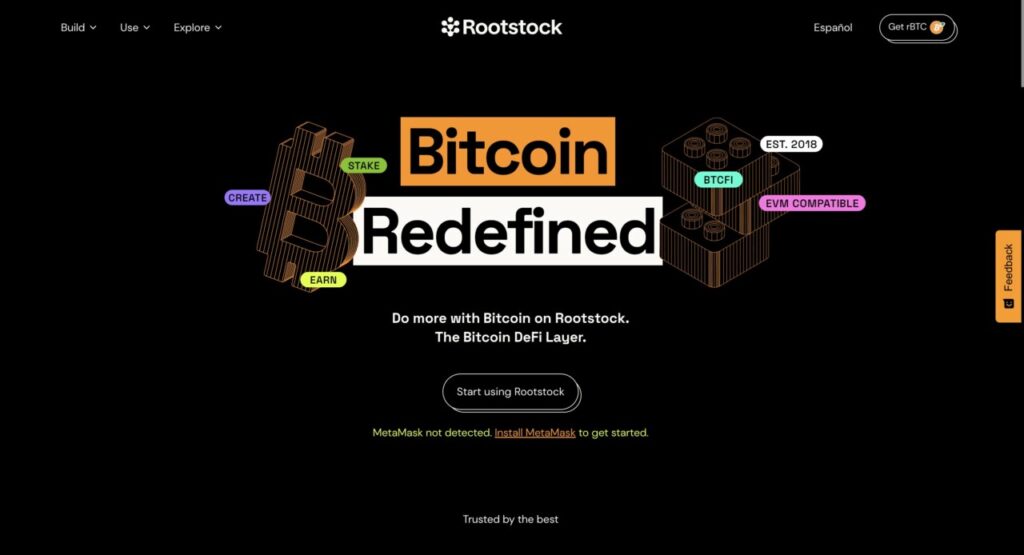
RSK utilizes a merged mining method, which allows Bitcoin miners to mine both networks simultaneously. This approach strengthens the security of RSK as it inherently leverages the computational power of Bitcoin.
By combining the economic characteristics of Bitcoin and the development flexibility of Ethereum, RSK is a strategic platform for expanding the reach of Bitcoin-based DeFi. This cross-ecosystem collaboration reinforces Bitcoin’s position in the decentralized application landscape.
Liquid Network: Infrastructure for Institutional Transaction Needs
Liquid Network is designed as a federative sidechain targeting the needs of exchanges, financial institutions, and professional traders who require higher transaction speeds and privacy levels. Through the peg system, BTC is converted into L-BTC and can be moved within the Liquid network with much shorter confirmation times. Liquid also supports a secret transaction feature that hides the amount and type of assets in the transfer.
By supporting asset tokenization and stablecoin issuance, Liquid provides an important foundation for Bitcoin-based capital markets. The network enables the rapid movement of large-scale funds between platforms, which crypto exchanges desperately need.
While not intended for retail transactions, Liquid strengthens Bitcoin’s position in institutional environments that require high speed and efficiency. This places Liquid as a critical component in the Bitcoin-based financial architecture.
Also read: Bitcoin (BTC) Decline Prediction by Peter Schiff: Will December Be Gloomy?
Merlin Chain: A New Generation of Zero-Knowledge-based Layer-2
Merlin Chain comes as a modern Layer-2 solution with zero-knowledge rollup (ZK-rollup) technology. Instead of logging every transaction on Bitcoin’s main network, Merlin groups transactions off-chain and sends cryptographic proof to Bitcoin for validation.

This approach increases capacity and efficiency without compromising the level of security that characterizes Bitcoin. ZK technology also brings increased privacy and cost savings.
Merlin’s compatibility with Ethereum development tools allows developers to build sophisticated applications on the Bitcoin ecosystem without technical barriers. The network features Bitcoin bridge and oracle integration, making it suitable for DeFi, gaming, and next-generation decentralized applications. Although still evolving, Merlin represents the future direction of more flexible and high-performance Layer-2 Bitcoin development.
Conclusion
Layer-2 solutions have played an important role in expanding Bitcoin’s capabilities as a network that can be used on a global scale. These networks speed up transactions, lower fees, and open up Bitcoin’s use for smart contracts and tokenization. Rather than competing with other blockchains, Bitcoin is evolving as a secure settlement layer, while its functional expansion is being carried out by Layer-2 networks that continue to innovate in the cryptocurrency space.
FAQ
What are the main functions of Layer-2 solutions in the Bitcoin ecosystem?
Layer-2 serves to increase the capacity and speed of transactions without changing the Bitcoin protocol, thus enabling wider use of Bitcoin.
When is Lightning Network most utilized?
Lightning is most commonly used for fast transactions such as micropayments, merchant payments, and cross-border transfers with low fees.
How does Stacks extend the capabilities of Bitcoin?
Stacks bring smart contracts and dApps to the Bitcoin ecosystem by utilizing data settlement on the main Bitcoin network.
What are the benefits of Liquid Network for financial institutions?
Liquid provides high transaction speeds, enhanced privacy, and tokenization support needed by institutions and crypto exchanges.
Why is Merlin Chain considered innovative?
Merlin utilizes ZK-rollup technology that enables enhanced performance, privacy, and advanced application compatibility.
That’s the latest information about crypto. Follow us on Google News to get the latest crypto news about crypto projects and blockchain technology. Also, learn crypto from scratch with complete discussion through Pintu Academy and stay up-to-date with the latest crypto market such as bitcoin price today, xrp coin price today, dogecoin and other crypto asset prices through Pintu Market.
Enjoy an easy and secure crypto trading experience by downloading Pintu crypto app via Google Play Store or App Store now. Also, get a web trading experience with various advanced trading tools such as pro charting, various types of order types, and portfolio tracker only at Pintu Pro.
*Disclaimer
This content aims to enrich readers’ information. Pintu collects this information from various relevant sources and is not influenced by outside parties. Note that an asset’s past performance does not determine its projected future performance. Trading crypto carries high risk and volatility, always do your own research and use cold hard cash before investing. All activities of buying and selling bitcoin and other crypto asset investments are the responsibility of the reader.
Reference
- Finance Feeds. Top 5 Bitcoin Layer-2 Solutions Expanding Bitcoin’s Real-World Utility. Accessed December 6, 2025
- Featured Image: Generated by Ai