7 facts about the Ethereum (ETH) Glamsterdam 2026 upgrade that the crypto community is monitoring

Jakarta, Pintu News – Ethereum is trending again among blockchain developers after the latest development of the next major upgrade, named Glamsterdam, was hunted by the community due to its clearer target to be activated in 2026 based on development roadmap data and statements from Ethereum’s core development team. This upgrade is an important conversation in the cryptocurrency market as it will shape the technical direction of the network after the release of Fusaka.
1. What is Glamsterdam and Why it is Monitored
Glamsterdam is an Ethereum hard fork scheduled to go live in 2026 as part of the twice-yearly upgrade schedule that the development team adopted to deliver incremental improvements. The goal is to strengthen Layer-1 efficiency and address issues of centralization and network state bloat.
This upgrade has received attention for its focus on deeper architectural changes rather than just a series of small features, with several major Ethereum Improvement Proposals (EIPs) under consideration. This reflects the community’s commitment to more mature technical developments without causing major surprises at a single point in time.
With Fusaka having just finished testing and launched on the main network, attention turns to Glamsterdam as the next step in Ethereum’s roadmap.
Also Read: 5 Important Facts about the Trending Halving Bittensor (TAO) in the Crypto World
2. Key Features to Consider for Glamsterdam

Some of the EIP proposals that Glamsterdam is focusing on include enshrined proposer-builder separation (ePBS), which aims to reduce the risk of centralization in block creation, and block-level access lists that simplify data access at the block level.
Other proposals such as gas repricings aim to make Ethereum Virtual Machine (EVM) execution costs more closely aligned with real resource usage, so that gas efficiency can improve on the base-level network.
These changes show a move towards choosing fundamental technical aspects to strengthen the performance of a top crypto like Ethereum without simply adding application features.
3. 2026 Activation Schedule and Target
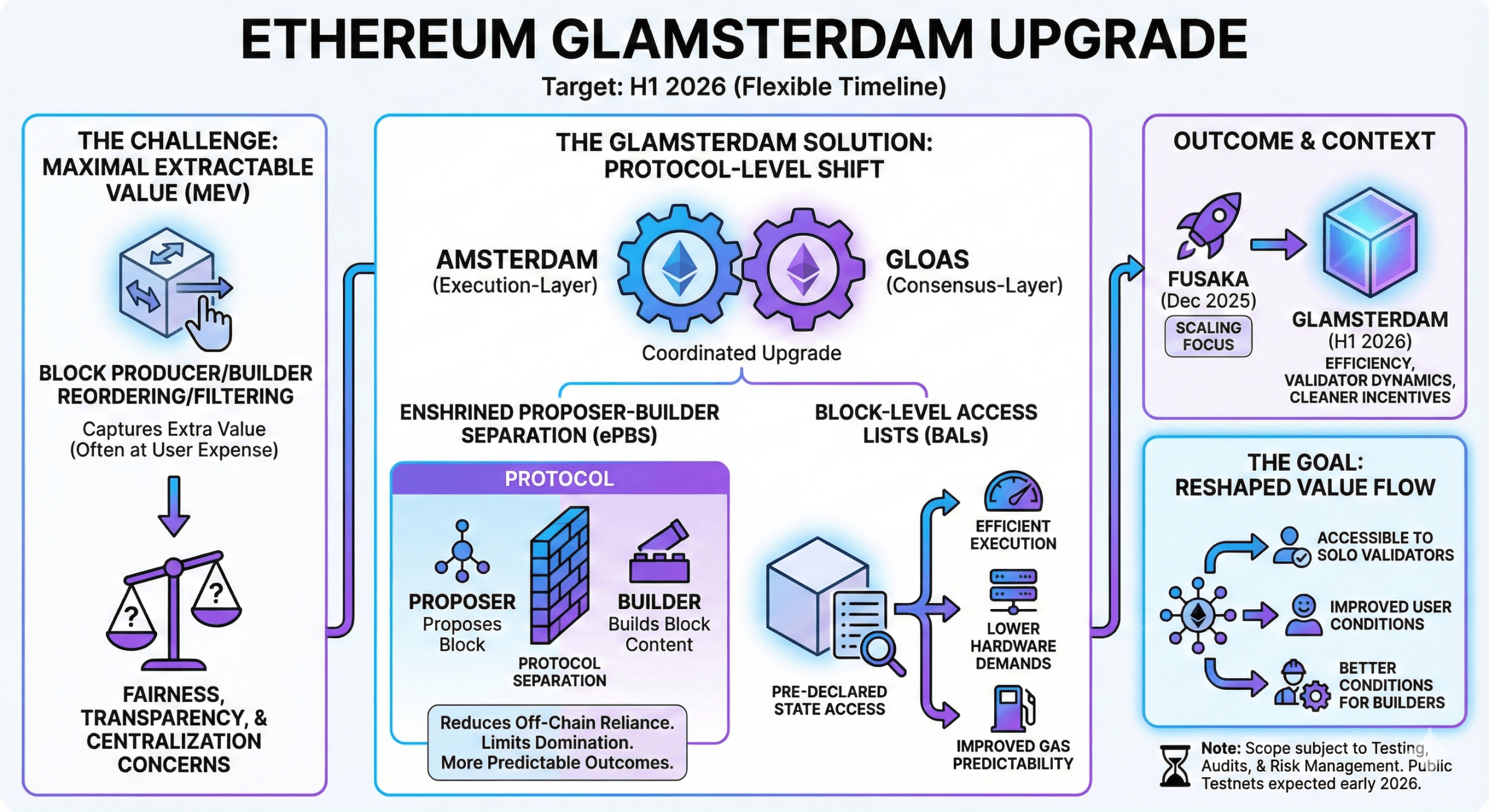
According to Ethereum developer discussions, Glamsterdam is projected to be active in the first half of 2026, although the final date is still dependent on the progress of verification and testing on the testnet before being released to the mainnet.
The process of finalizing the core features of Glamsterdam is likely to be completed by the end of 2025, and further technical discussions are scheduled to restart in early 2026.
This schedule is part of Ethereum’s efforts to implement a periodic release structure, which is expected to make technical planning and community coordination more predictable in the future.
4. Glamsterdam’s Relationship with Upgrades Afterward (Hegota)
The core developers have also named the second upgrade planned for 2026 after Glamsterdam as Hegota, which is a combination of track execution (“Bogota”) and consensus (“Heze”).
Hegota is scheduled to catch up with Glamsterdam in the second half of 2026 and will absorb features that didn’t make it to Glamsterdam, as well as additional innovations such as reduced storage requirements through data structures like Verkle Trees.
This naming and planning suggests Ethereum is focusing on continuous incremental development, rather than large packages all at once, to improve the efficiency and scalability of the protocol.
5. Key Challenges and Risks
Some analysts mentioned that the process of creating an upgrade like Glamsterdam requires a great deal of coordination between the client team, protocol developers, and network validators because the architectural changes are quite complex.
The biggest risk is the possibility of delays or revisions as core features such as ePBS and BALs are still in the discussion and testing phase, which could affect the release schedule if there are important technical findings.
In addition, significant changes at the base chain level require rigorous testing so as not to exacerbate issues such as state bloat, which is a growing load of data on the network.
6. Implications for the Cryptocurrency Ecosystem
Glamsterdam will contribute directly to a phase in Ethereum’s roadmap called Surge, which is an ongoing effort to expand the network’s throughput and support capabilities for Layer-2 and rollup applications.
The upgrade is also being monitored as an indicator of Ethereum’s technical performance in the medium term, which could affect market perceptions of the network’s ability to handle the mass use of DeFi and smart contracts.
With a clearer timetable for 2026, the community of cryptocurrency developers and users has a better idea of the direction the Ethereum network will evolve in.
7. When can we observe the development?
Observations of Glamsterdam’s progress can start from the finalization of core features in late 2025, when the development team releases new roadmap updates and the wider testnet goes live.
Public discussions on the forum and All Core Developers Execution (ACDE) will be the main source of technical information and schedule changes.
The crypto community and analysts will be kept in the loop with updates on each phase, especially during testnet trials and the announcement of the exact date of mainnet activation.
Also Read: Avalanche Price Prediction 2025-2030: Can AVAX Reach $100?
Follow us on Google News to get the latest information about crypto and blockchain technology. Check Bitcoin price today, Solana price today, Pepe coin and other crypto asset prices through Pintu Market.
Enjoy an easy and secure crypto trading experience by downloading Pintu crypto app via Google Play Store or App Store now. Also, get a web trading experience with various advanced trading tools such as pro charting, various types of order types, and portfolio tracker only at Pintu Pro.
*Disclaimer
This content aims to enrich readers’ information. Pintu collects this information from various relevant sources and is not influenced by outside parties. Note that an asset’s past performance does not determine its projected future performance. Crypto trading activities are subject to high risk and volatility, always do your own research and use cold hard cash before investing. All activities of buying andselling Bitcoin and other crypto asset investments are the responsibility of the reader.
FAQ
What is the Glamsterdam Ethereum upgrade?
The Glamsterdam upgrade is an Ethereum hard fork planned to go live in 2026 to increase Layer-1 efficiency, reduce centralization, and improve gas structures and data access.
Why is this upgrade important for the Ethereum network?
Glamsterdam focused on improving the core architecture of the network, including reducing external MEV dependency and simplifying costs, which impacts long-term scalability.
What does Glamsterdam have to do with Hegota?
Hegota is a follow-up upgrade planned after Glamsterdam in 2026, with additional focus such as Verkle Trees and other optimizations that didn’t make it into Glamsterdam.
When can we see Glamsterdam’s implementation?
Glamsterdam’s activation target is the first half of 2026, but the exact date depends on the results of trials and final consensus among developers.
Reference
- Bitcoin News. Ethereum’s Glamsterdam Upgrade Takes Shape as 2026 Target Comes Into Focus. Accessed December 22, 2025