Chainlink Long Term Prediction: LINK Projected to Reach $45 – $75 in 2026

Jakarta, Pintu News – Chainlink is showing very promising prospects ahead of 2026 with the launch of Cross-Chain Interoperability Protocol (CCIP) version 1.5. With massive adoption by financial institutions and technical improvements, LINK is predicted to reach a price range of $45-$75. This analysis will delve deeper into the factors driving these optimistic predictions.
CCIP v1.5: New Interoperability Standard
CCIP version 1.5, launched early in 2026, brings innovation with the integration of self-service tokens that allow projects to customize rate limits and pool contracts. The zkRollup support also increases the scalability of the system.
Coinbase has chosen CCIP as the exclusive bridge infrastructure for all their Wrapped Assets, including wrapped Bitcoin , wrapped Ethereum , and others, with a total market capitalization of $7 billion.
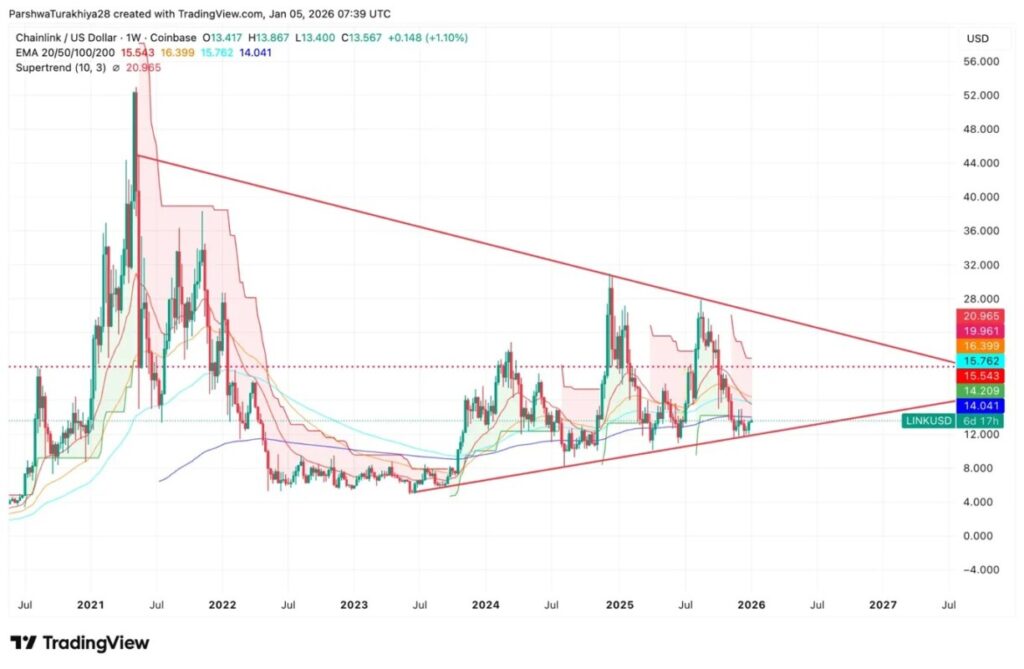
Lido also adopted CCIP for their staked Ethereum (ETH) across the chain, with a total locked value of $33 billion. CCIP is no longer experimental but has become production infrastructure. CCIP’s transfer volume jumped by 1,972% to $7.77 billion per year, signaling an excellent product-market fit.
Also read: Ripple’s Long-Term Predictions: XRP Projected to Break $24 by Analysts
Automated Compliance Engine (ACE) and Institutional Adoption
ACE is scheduled to launch in 2026, integrating KYT’s Proof of Reserve Chainlink and Chainalysis tools for regulatory compliance automation of tokenized assets. By incorporating KYC/AML compliance directly into smart contracts, ACE removes a key barrier preventing institutional adoption.
Ondo Finance’s tokenized securities platform has achieved $2 billion in volume and $370 million in total value locked (TVL) using Chainlink’s oracles, demonstrating Chainlink’s important role in institutional tokenization.
Also read: Top 4 Crypto that Did a Massive Token Unlock January 2026
Data Streams Expansion and Chainlink Runtime Environment
The Data Streams expansion in the first quarter of 2026 targets high-frequency trading applications and real asset markets with real-time pricing for derivatives. This enables sub-second latency that cannot be supported by traditional oracle architectures, critical for futures, options and algorithmic trading strategies.
Success in institutional pilots could potentially lead to production deployments worth billions of dollars in transaction value. The Chainlink Runtime Environment (CRE), launching in 2025, enables multi-chain, multi-axle and multi-jurisdictional workflows.
Major banks such as J.P. Morgan and UBS have leveraged CCIP for cross-chain transactions and tokenized fund workflows, creating a platform effect where institutional developers opt for Chainlink infrastructure.
Conclusion
With multiple innovations and strong institutional adoption, Chainlink is positioned for significant growth by 2026. The optimistic price prediction is supported by the adoption of advanced technologies and strategic partnerships that strengthen Chainlink’s position in the market. Investors and market watchers should take note of these dynamics when considering Chainlink in their portfolios.
That’s the latest information about crypto. Follow us on Google News to get the latest crypto news about crypto projects and blockchain technology. Also, learn crypto from scratch with complete discussion through Pintu Academy and stay up-to-date with the latest crypto market such as bitcoin price today, xrp coin price today, dogecoin and other crypto asset prices through Pintu Market.
Enjoy an easy and secure crypto trading experience by downloading Pintu crypto app via Google Play Store or App Store now. Also, get a web trading experience with various advanced trading tools such as pro charting, various types of order types, and portfolio tracker only at Pintu Pro.
*Disclaimer
This content aims to enrich readers’ information. Pintu collects this information from various relevant sources and is not influenced by outside parties. Note that an asset’s past performance does not determine its projected future performance. Crypto trading activities have high risk and volatility, always do your own research and use cold cash before investing. All activities of buying and selling bitcoin and other crypto asset investments are the responsibility of the reader.
Reference
- CoinEdition. Chainlink 2026 Prediction: Institutional RWA Push and CCIP v1.5 Target 45-75. Accessed on January 6, 2026
- Featured Image: Token Metrics


