World Oil Prices Today, March 3, 2026
Jakarta, Pintu News – The effective closure of the Strait of Hormuz following the US-Israeli attack on Iran has triggered an unprecedented energy supply crisis. The impact was felt most heavily by Asian countries, as tanker traffic through the world’s most crucial oil narrowing came to a near standstill.
Japan and South Korea are considered to face the greatest risk, given that both are highly dependent on fossil fuel imports whose shipments pass through the Strait of Hormuz. Then, how will world oil prices move today?
World Oil Price Today
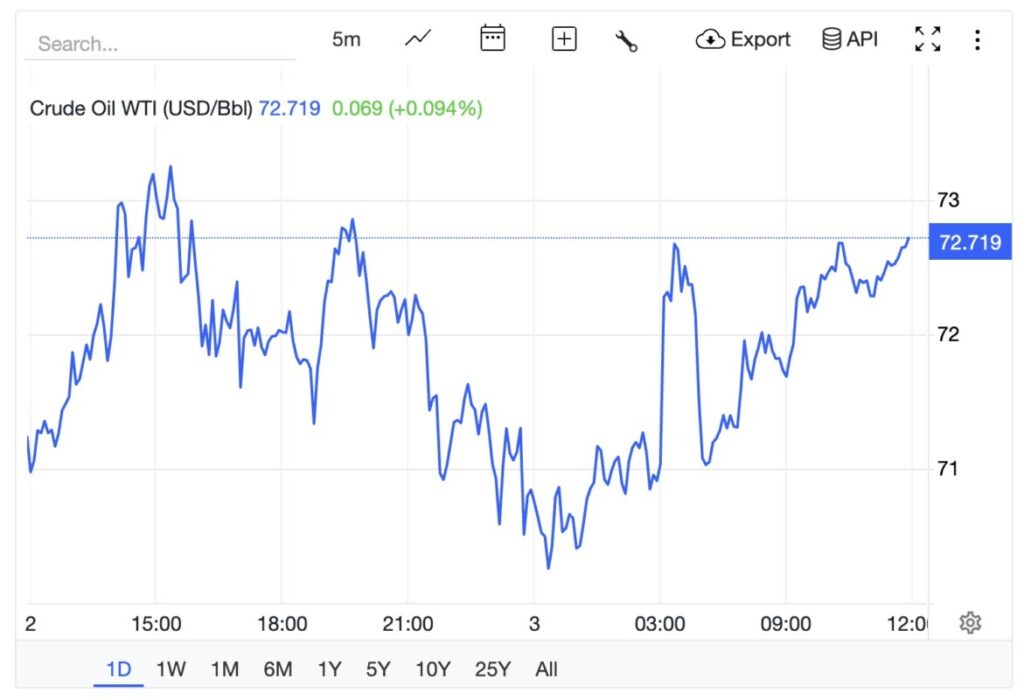
The price of WTI crude oil on the chart stood at $72.719 (Rp1,226,770) per barrel, a slight gain of $0.069 (Rp1,164) or about 0.094%. Intraday, the movement was volatile: the price briefly climbed to near the $73 area, then turned lower to the $71 range before recovering.
Read also: Semar Nusantara Gold Price Today, Tuesday, March 3, 2026
Towards the end of the period on the chart, WTI moved up gradually and tested the $72.7 (Rp1.23 million) area again, indicating a recovery after a downward phase in the middle of the session.
Tanker Traffic Stops
The cost of chartering a supertanker to transport oil from the Middle East to China soared to a record high, surpassing $423,000 per day on Monday, or about double the Friday level, according to LSEG data. Iran’s Revolutionary Guard Corps declared the Strait of Hormuz closed and warned it would fire on any ship trying to pass.
The disruption comes in the wake of the killing of Iran’s Supreme Leader Ayatollah Khamenei in a joint US-Israeli raid on Saturday, which prompted Tehran to launch retaliatory strikes in a number of Gulf countries. At least four ships were reportedly hit in Gulf waters, while major shipping companies and insurers practically pulled out of the route.
Kpler confirmed that commercial operators withdrew after insurers withdrew war risk cover, creating a de facto closure. Currently, only a small percentage of Iranian- and Chinese-flagged vessels – many of which operate outside of Western insurance and classification systems – continue to pass through.
Oil Price Projections are Sharply Divided
Brent crude oil closed at around $78 (Rp1,315,860) per barrel on Monday, up approximately 9% from Friday’s close. However, analysts’ projections differ widely, mainly determined by how long the supply disruption lasts.
Read also: Gold Jewelry Price Today (March 3, 2026): Up or Down?
The closure of this route creates a double supply shock: exports are held up, while OPEC’s spare capacity is also “locked” behind the blockade. Analysts’ forecasts range from the late $80s per barrel (e.g. $88 (Rp1,484,560) to $89 (Rp1,501,430) if the disruption subsides quickly, to $100-$120 (Rp1,687,000-Rp2,024,400) per barrel if the standoff persists.
In extreme scenarios, risk premiums can push prices beyond model-based estimates.
Inadequate Alternative Paths
Replacement route options are limited. Saudi Arabia’s East-West pipeline and the Abu Dhabi (UAE) pipeline combined provide only about 3.5 million barrels per day of unused capacity – less than 20% in the event of a complete shutdown.
The release of strategic reserves could help ease pressure, but IEA member countries represent less than half of global oil demand.
With Iran declaring “total war” on Israel and the US, this crisis emphasizes the fragility of fossil fuel supply chains for Asian economies. At the same time, the situation has the potential to accelerate the energy diversification agenda to reduce dependence on supply lines that are vulnerable to disruption.
Follow us on Google News to stay up to date with the latest in crypto and blockchain technology. Check Bitcoin price, usdt to idr and tokenized nvidia stock price through Pintu Market.
Enjoy an easy and secure crypto trading and crypto gold investment experience by downloading the Pintu crypto app via Play Store or App Store now. Also, experience web trading with advanced trading tools such as pro charting, various order types, and portfolio tracker only at Pintu Pro.
*Disclaimer
This content aims to enrich readers’ information. Pintu collects this information from various relevant sources and is not influenced by outside parties. Note that an asset’s past performance does not determine its projected future performance. Crypto trading activities are subject to high risk and volatility, always do your own research and use cold hard cash before investing. All activities of buying and selling Bitcoin and other crypto asset investments are the responsibility of the reader.
Reference:
- BeInCrypto. Strait of Hormuz Shutdown Shakes Asian Energy Markets. Accessed on March 3, 2026