Blue Chip Stocks VS Pump-and-Dump Stocks

In the world of stock investment, the terms blue chip stocks and “fried stocks” often appear. What exactly are blue chip stocks and fried stocks? In simple terms, blue chip stocks generally come from issuers with strong fundamentals, large market capitalization, relatively stable earnings performance, and high liquidity. On the contrary, fried stocks are synonymous with extreme price movements, sudden spikes in transaction volume, and are often driven by short-term speculation and maneuvering by certain parties. To find out more about blue chip stocks and fried stocks, read this article until the end!
Article Summary
🏢 Blue chip stocks are generally issued by large, long-term reputable companies with strong financial conditions.
♾️ In the early 1920s, the term “blue chip” was first used to describe high-quality stocks.
🍤 Pump-and-dump stocks tend to move unnaturally, are highly volatile, driven by speculative activity, and volume spikes that are not proportional to fundamental information.
🖥️ If you want to avoid the risk of pump-and-dump stocks, you need to thoroughly research the company; look at the quality of management, performance track record, & financial condition.
What are Blue Chip Stocks?
Blue chip stocks are stocks of established companies that are known for their good reputation, proven business quality and stable financial condition. Generally, blue chip issuers are market leaders in their sectors and have a very large market capitalization of billions of dollars.
Blue chip stocks are usually in high demand because they have a long track record of generating relatively consistent profits and/or regularly paying dividends. Because of this characteristic, blue chip stocks are often important components in many of the world’s prestigious indices, such as the Dow Jones Industrial Average, Nasdaq 100, and S&P 500 in the United States, TSX-60 in Canada, and FTSE in the United Kingdom.
The main reason behind many investors choosing blue chip stocks is the stability of their earnings. In addition, blue chip stocks often pay out dividends that tend to stabilize and even increase over time, which can help offset temporary drops in stock prices.
When the economy slows down, blue chip stocks are often an option to maintain portfolio value. As an illustration, during the financial crisis of the last decade, some blue chip companies were able to survive, and investors who held their shares had the opportunity to recover their investment performance as market conditions improved.
In general, investors in blue chip stocks have higher expectations of regular dividend receipts as well as better portfolio protection against inflationary pressures.
The Origin of the Term “Blue Chip” in Stocks
According to the Corporate Finance Institute, the term “blue chip” was first used to describe high-quality stocks in the early 1920s by Oliver Gingold, a Dow Jones employee. While near a ticker machine at a brokerage firm, he noticed a number of stocks trading at very high price ranges-around $200, $250, or more.
Gingold told Lucien Hooper of W.E. Hutton & Co. that he wanted to return to the office to write about these “blue chip stocks”. Since then, the term has been used to refer to stocks that are considered high value, in line with the meaning of “blue chip” in the game of poker which usually has a larger chip value. However, blue chip stocks do not necessarily have to be expensive; the main emphasis is on the quality of the company and the resilience of its fundamentals.
Characteristics of Blue Chip Stocks
Although each company has a different character, blue chip stocks generally have some key characteristics that make them more reliable as investment instruments, such as:
- Strong Financial Performance: Blue chip companies tend to have stable earnings, healthy cash flows, and relatively manageable debt levels. This kind of balance sheet structure gives them room to stay afloat when the economy weakens and still be able to expand when a recovery occurs.
- Long Operational Track Record: Most have operated successfully for decades and through various phases of the economic cycle. Such historical consistency reinforces investor confidence in the quality of the business.
- Industry Leadership: They are generally the dominant players in their respective sectors. Whether in technology, finance or consumer goods, blue chip companies often play a role in setting industry standards, rather than simply following trends.
- Consistent Dividends: Many blue chip issuers routinely pay dividends, some even known as “Dividend Aristocrats” for raising dividends consecutively for more than 25 years. This character is attractive to investors who pursue dividend income as well as value growth.
- Large Market Capitalization: Blue chip companies typically have very large valuations-from tens to hundreds of billions of dollars-reflecting market dominance as well as investor confidence.
- Lower Volatility: Due to the scale of their business and stability, blue chip stocks generally move more moderately than small-cap stocks, so their performance tends to be more “smooth” when the market is volatile.
Pros of Blue Chip Stocks
Blue chip stocks are generally seen as a relatively safe haven when economic conditions weaken. Companies listed in the Dow Jones index, such as Coca-Cola (KOON), General Electric and Nvidia , have been known to weather major economic downturns over the years, thanks to their strong balance sheets and quality management. In crisis situations, such companies often have the capacity to acquire weakened or marginalized competitors, so that their financial position can be further strengthened after the crisis has passed.
In addition, as mentioned earlier, blue chip stocks tend to pay dividends in a stable and sustainable manner. A number of studies have shown that stocks that regularly pay dividends are often more resilient to pressure when the market enters a bearish phase.
For some investors, dividends can be a source of income in retirement, while their shareholdings can be inherited as a form of wealth transfer to family.
Examples of Blue Chip Stocks
Some examples of blue chip stocks that are widely recognized on a global level are Microsoft and Apple . These two giant companies are often categorized as strong blue chips due to their worldwide popularity. Their products and service ecosystems are used by hundreds of millions of people, and are backed by a long track record of innovation and business success that has been tested over decades.
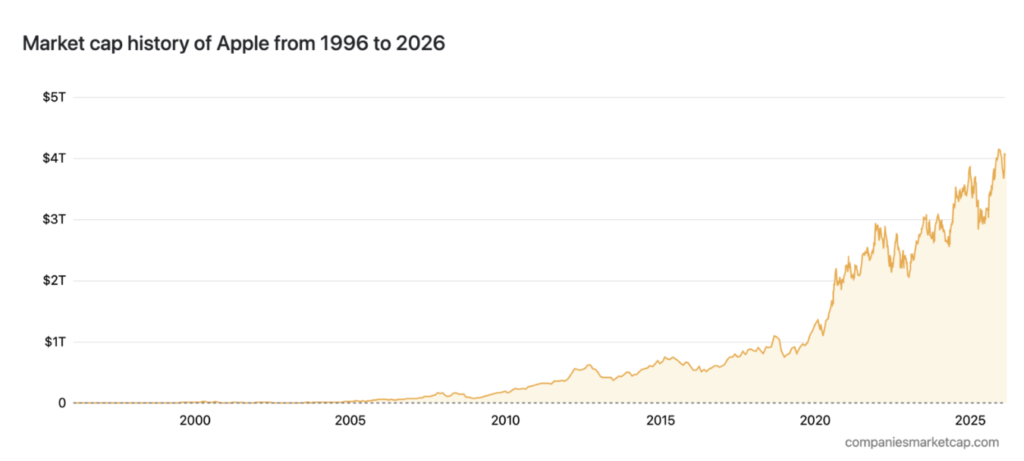
As can be seen from the chart above, Apple’s market capitalization continues to surge year after year. In the 2020-2025 period, Apple’s market capitalization exceeded $2 trillion and continued to rise to above $3 trillion in the 2023-2025 period. As of February 2026, Apple’s market cap is around $4.049 trillion, making it one of the most valuable companies in the world.
In addition, Johnson & Johnson is also often cited as an example of a classic blue chip. The company has been in operation for more than a century and has repeatedly demonstrated its adaptability to changing economic conditions. Its diverse product portfolio-especially in consumer lines-makes its revenue sources more distributed, supporting the blue chip character of stability.
Amazon is another example of a blue chip stock, especially in the growth-oriented category. The e-commerce giant recorded standout performance as online shopping surged in 2020, when social restrictions and health guidelines encouraged consumers to shift from shopping in physical stores to digital transactions.
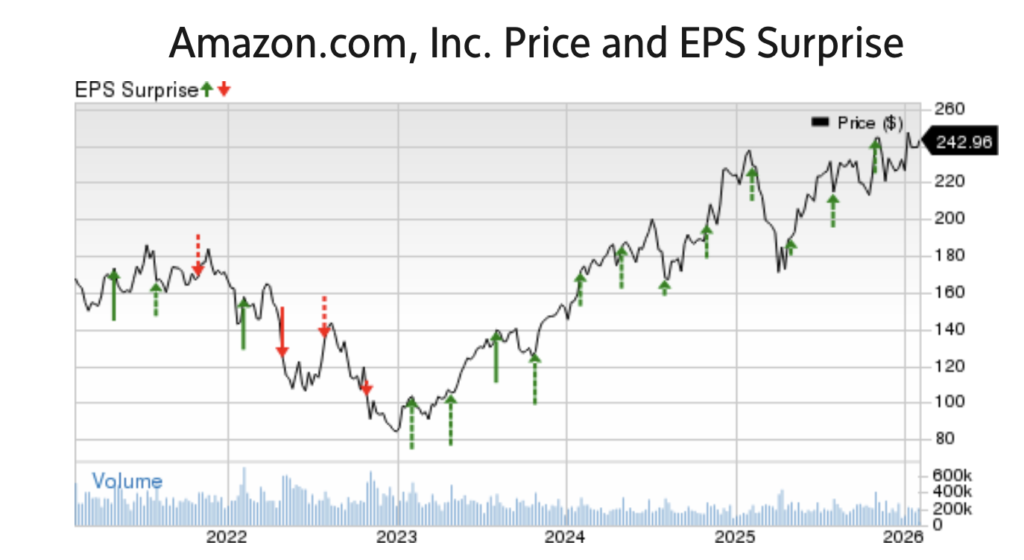
Based on the chart data above, Amazon shows a strong track record of recording earnings performance above market expectations. In the last reported quarter, the company posted an earnings surprise of 23.42%. In fact, in the last four consecutive quarters, Amazon’s earnings have always exceeded the Zacks Consensus Estimate, with the average earnings surprise reaching 22.47%.
Examples of Blue Chip Stocks in Indonesia
Now that you know some examples of global blue chip stocks, here are some examples of popular blue chip stocks in Indonesia:
- PT Aneka Tambang Tbk (ANTM)
PT Aneka Pertambangan Tbk or Antam is a company engaged in nickel, bauxite and gold mining. Furthermore, ANTM is a member of the LQ45 and IDX30 indices, with significant demand. As of February 16, 2021 alone, ANTM’s market capitalization has reached 33.52 trillion.
- Telekomunikasi Indonesia (TLKM)
TLKM is a state-owned telecommunications company with a dominant position in the Indonesian market. From an investor perspective, TLKM is often viewed as a defensive stock due to its relatively stable business profile and consistent dividend payout track record, making it suitable for long-term income strategies.
- Astra International Tbk (ASII)
ASII is a large conglomerate with exposure to various key sectors, ranging from automotive, financial services, heavy equipment, agribusiness, infrastructure, to technology and property. The diversification across sectors helps ASII to cushion the pressure when one industry weakens, thus its performance movement is often used as a handy indicator to read Indonesia’s macroeconomic dynamics.
- Indofood CBP Sukses Makmur Tbk (ICBP)
ICBP, as part of the Indofood group, is known as a leader in the packaged food category, particularly instant noodles through its Indomie brand. Its business model is often categorized as defensive as its products are close to daily consumption needs, so demand tends to be maintained in various economic conditions.
Investment Strategy in Blue Chip Stocks
Investment strategies in blue chip stocks generally emphasize long-term discipline, as their main advantages lie in business quality, cash flow resilience, and dividend consistency. Here are some investment strategies that you can apply:
- First, set an investment goal and period (e.g. 5-10 years of asset accumulation or dividend income), and then adjust the portion of blue chip stocks within the asset allocation framework to align with risk tolerance. The principle of diversification remains important: while blue chips are relatively stable, a portfolio should not rely on one stock, one sector or one asset class, so that volatility and issuer-specific risks are minimized.
- Second, use a dollar-cost averaging approach to reduce the risk of mistiming and maintain investment consistency as prices fluctuate. This strategy is especially relevant for retail investors who invest regularly from monthly cash flow.
- Third, if the objective includes long-term value growth, consider dividend reinvestment to strengthen the compounding effect, especially for issuers with stable/growing dividend policies.
- Fourth, apply valuation and quality discipline: evaluate basic fundamentals such as profitability and performance stability, as well as price reasonableness through metrics such as P/E, then compare across similar issuers so that decisions do not simply follow sentiment.
How to Buy Blue Chip Stocks
Buying blue chip stocks practically follows the procedure of buying stocks in general; the difference lies in the issuer selection stage which emphasizes quality, large capitalization, and performance track record.
- The first step in buying blue chip stocks is to select a legal and suitable broker/securities firm and open an account. At the account opening stage, investors are advised to read the relationship/service summary document (e.g. relationship summary and fees), understand the fee structure, and check the background of the broker/firm to reduce the risk of choosing the wrong service provider.
- Once the account is active, investors make a deposit (funding) in order to be ready to place orders.
- The next step is to determine the “container” of blue chip exposure: buying stocks individually (stock picking) or buying baskets of stocks through ETFs/index funds that focus on large-cap companies.
- After selecting the instrument, the investor executes the transaction through the broker’s platform by entering the number of shares/units, then selecting the order type.
- Finally, understand how your orders are processed. When you place an order, your broker may channel it to multiple trading venues (e.g. through electronic systems/networks). Because of this, the price and speed of the transaction may vary depending on how busy it is (liquidity) and market conditions at the time.
Generally, it's safer if you start buying small amounts first, don't jump on the bandwagon for no good reason, and adjust the frequency of transactions to your investment goals.
What is a Pump-and-Dump Stocks?

In the context of the Indonesian stock market, “fried stocks” is an informal term for stocks whose price movements tend to be unnatural and highly volatile in the short term, often driven by speculative activity, volume/price action spikes that are not proportional to fundamental information, as well as potential manipulative practices.
In practice, the pattern often associated with “fried foods” involves a rapid price increase due to promotion/rumor followed by a sharp correction when buying interest weakens or certain parties sell. Because of this characteristic, the risks are usually higher: price gaps are large, liquidity may suddenly dry up, and retail investors may be trapped buying at peak prices.
From an exchange surveillance perspective, one signal that is often relevant to this phenomenon is the announcement of Unusual Market Activity/UMA, which is a condition when the price and/or volume movement of a stock is considered unusual compared to its normal pattern. UMA is not a verdict of violation, but a warning that speculative risks are increasing and investors need to exercise caution and due diligence.
In the international literature and investor guides, the closest mechanism to the “fried” pattern is “pump-and-dump”, which is a manipulative scheme that “pumps up” the price through misleading/hyped information to trigger buying, then the perpetrator sells at a high price so that the price plummets and late investors bear the loss.
Examples of Pump-and-Dump Stocks in Indonesia
Fried stocks or pump-and-dump stocks in Indonesia generally do not refer to specific issuers, but rather to trading behavior patterns and microstructure characteristics that make a stock vulnerable to rapid price spikes and crashes.
A common feature is aggressive price increases (often for days or weeks) that are not followed by commensurate fundamental changes, such as clear revenue/profit growth, verified material business contracts, or improved performance reflected in financial reports. Movements are usually “led” by momentum rather than company information.
Characteristics of Pump-and-Dump Stocks
Like other types of stocks, pump-and-dump stocks can be used as an investment vehicle. However, potential investors need to be extra cautious as these instruments are highly speculative by nature, mainly due to their high volatility and low liquidity. In addition, fried stocks are also often the target of fraudulent practices. One example is the pump-and-dump scheme, where certain parties manipulate prices through misleading promotions or narratives for personal gain.
Here are some characteristics that make dump-and-dump stocks very high-risk:
- Low liquidity
Since many fried stocks are traded outside the main exchanges (over-the-counter (OTC), their liquidity tends to be limited. Investors are not always able to sell shares at the time they want. Small transaction volumes also make price movements sensitive; even relatively small-sized transactions can trigger large price spikes or drops.
- Limited historical information
Many fried stocks are issued by relatively new companies, which have little historical data. These companies often do not have a strong track record of operations, products, assets or revenues. As a result, the risk of investing is much higher as the quality of the business is untested.
- Lack of public information disclosure
Microcap companies issuing pump-and-dump stocks in some jurisdictions are not always required to file periodic reports with regulatory authorities (e.g. U.S. Securities and Exchange Commission/SEC or Financial Services Authority/OJK).
On the other hand, these stocks are also usually not covered by professional analysts from major financial institutions. Consequently, investors may find it difficult to obtain sufficient information to make truly data-driven investment decisions.
- No minimum listing requirements
Because they are generally traded on the OTC market, companies issuing pump-and-dump stocks do not always have to meet certain minimum standards that are customary for listings on major exchanges. The lack of these requirements can increase the variation in the quality of issuers and increase the risk to investors.
Case Example of Pump-and-Dump stocks
Examples of fried stocks or pump-and-dump schemes are often depicted in popular movies such as Boiler Room and The Wolf of Wall Street. These movies feature aggressive sales environments where brokers encourage the purchase of highly speculative stocks, including fried stocks, through misleading claims and financial incentives.
It shows how coordinated sales practices and manipulative promotions can create “fake” demand and artificially inflate prices. In such a situation, those who initiate the promotion can reap the benefits, while investors who don’t understand the pattern are left holding securities that quickly decline in value once the promotional activity stops.
Differences between Blue Chip and Pump-and-Dump Stocks
Pump-and-dump stocks usually carry a higher level of risk than many other investment instruments. In fact, early success can paradoxically lead to heavy losses, especially when price movements are heavily influenced by speculation and volatility.
In contrast, blue chip stocks come from well-established companies, with relatively clear business prospects and a more testable track record of performance. Therefore, comparing fried stocks and blue chip stocks often feels quite “straightforward” to understand the difference in risk profile and investment quality.
Long-Term Yields: Pump-and-Dump Stocks vs Blue Chip Stocks
Pump-and-Dump stocks
While they may look “cheap” and seem accessible, on average, fried stocks tend to deliver poor long-term results. Building a truly successful business is a difficult process, whereas setting up a company and offering shares to the public is often easier and lower cost.
In addition, pump-and-dump stocks are often easier to “play” than high liquidity stocks due to their relatively low transaction levels and high volatility. If these conditions are met with weak supervision in certain trading venues, plus the fact that it is relatively easy for such companies to spring up, then the risk of investment fraud and manipulative practices becomes more common in fried stocks.
Blue chip stocks
Blue chip stocks that are often recommended generally come from companies that have a history of profitability of at least 5-10 years. In principle, companies that are able to generate profits consistently tend to be safer than companies that are constantly losing money or only occasionally able to book profits.
In volatile markets, blue chip issuers can provide an additional layer of security for investors. The best blue chip companies usually offer an attractive combination: relatively moderate valuations (e.g. through P/E ratios, i.e. the ratio of share price to earnings per share), stable or increasing dividend yields (annual dividends divided by share price), as well as growth prospects that remain promising.
Dividend Income Sources: Pump-and-Dump Stocks vs Blue Chip Stocks
| Aspects | Pump-and-Dump Stocks | Blue Chip Stocks |
|---|---|---|
| Dividend potential | Rarely pay dividends | Generally distribute dividends regularly (in certain issuers also tend to increase) |
| Main source of return | More reliance on short-term capital gains and price momentum | Combination of medium-long term capital gains and dividend income |
| Payment consistency | Inconsistent; often no clear dividend policy | More consistent as supported by relatively stable earnings and cash flow |
| Resilience when prices fluctuate | Dividend income not usually a crutch; sharper impairment risk | Dividends can help cushion the impact of temporary price declines (depending on the condition of the issuer) |
| Risk profile | Higher; prone to extreme volatility and speculative dynamics | Relatively lower; volatility tends to be more moderate |
| Goal congruence | Short-term speculation/strategy; high risk | Passive income, long-term accumulation and portfolio stability |
Risks of Pump-and-Dump Stocks
There are several key risks of pump-and-dump stocks, including:
- High volatility: The price of pump-and-dump stocks can move in extreme ways, rising and falling sharply in a short period of time. This makes it difficult for investors to determine the right moment to buy or sell, and even makes buy-and-hold strategies for long-term growth difficult.
- Limited liquidity: When there is insufficient demand for transactions, investors risk getting “stuck” because it is difficult to find buyers. As a result, the process of exiting a position can be hampered or must be done at a less favorable price.
- Low transparency: As financial reporting obligations are not always robust, obtaining accurate information about pump-and-dump stocks can be difficult. For investors, this makes fundamental analysis-including an assessment of the company’s financial condition-more limited and investment decisions more susceptible to information bias.
Tips for Avoiding Pump-and-Dump Stocks
Recognizing the warning signs is the first step to avoiding pump-and-dump stocks. In addition, there are some practical measures that can be taken to prevent falling into the trap of pump-and-dump stocks, including:
Be skeptical
A critical attitude is the foundation of a rational investor. A credible financial advisor will generally not contact potential clients via social media out of the blue. It is important to note that legitimate investments always come with risks; no instrument promises a guaranteed return. Therefore, take the time to objectively assess each recommendation before acting.
Do your research before investing
Research the company thoroughly before deciding to invest. Pay attention to the quality of management, performance track record, financial condition, and reputation. The stronger the information base, the less chance of a decision being driven solely by hype.
Cross-verification of information
Beware of urgent appeals such as “buy now”. Test such claims by checking multiple sources. Credible financial media, regulatory reporting documents, and analysis from competent parties can help assess whether a narrative is plausible or just hype.
Report suspicious activity
If the indications point to a pump-and-dump scheme, reporting can help protect other investors. In the context mentioned, the recommended step is to report the alleged fraud to the local regulator so that it can be followed up according to the applicable legal mechanisms.
How to Buy Blue Chip Stocks on Pintu
On the Pintu app, you can gain exposure to blue chip stocks through a tokenized system. This means that the stock or ETF is tokenized on the blockchain and its value follows the price movement of the original asset. Because they are tokenized, you can buy fractionally, so you don’t have to buy a whole share.
In addition, Pintu also provides various blue chip stock tokens such as AAPLX, NVDAX, Coca-Cola (KO), JPMorgan , and other similar assets in the Tokenized Stocks Market. Purchases of these blue chip stock tokens can start as low as Rp11,000, and you can buy and sell at any time (24/7), without waiting for exchange opening hours.
Here’s how to easily buy blue chip stocks on Pintu:
- Enter the Pintu homepage.
- Go to the Market – Tokenized Stocks page.
- Search and select the crypto asset you want to trade.
- Enter the amount you wish to purchase, and follow the rest of the steps.
Conclusion
The comparison of blue chip and pump-and-dump stocks is basically a comparison between fundamental quality-based investments and speculative momentum-based investments. Blue chip stocks are generally backed by more stable business performance, more established governance, and a relatively consistent track record of earnings and/or dividends, making them more relevant for long-term accumulation, dividend income generation, and portfolio stabilization.
In contrast, pump-and-dump stocks tend to move in extremes due to thin liquidity, limited information transparency, and susceptibility to manipulative narratives and practices, hence the risk is higher and requires much stricter risk management discipline.
Reference:
- Ali Perdue. Pump-and-dump schemes: how to spot and avoid fraud. Accessed on March 5, 2026
- CFI. Blue Chip. Accessed on March 5, 2026
- Dane Lane. How to spot a pump and dump scheme. Accessed on March 5, 2026
- Investor.gov (U.S. SEC). Asset Allocation, Diversification, and Rebalancing 101. Accessed on March 5, 2026
- Megan Werner. What are penny stocks? Accessed on March 5, 2026
- MSID Investment Education. 10 Blue Chip Stocks with Strong Fundamentals. Accessed on March 5, 2026
- Rajeev Dhir. Understanding Pump-and-Dump Schemes: Definition, Illegality, and Types. Accessed on March 5, 2026
- Scott Clayton. Penny Stocks vs. Blue Chip Stocks. Accessed on March 5, 2026
- Zack Investment Research. Should Investors Buy Amazon Stock Ahead of Q4 Earnings Release? Accessed on March 5, 2026
Share
Table of contents
Related Article

See Assets in This Article
NVDAX Price (24 Hours)
Market Capitalization
-
Global Volume (24 Hours)
-
Circulating Supply
-

