Market Analysis Jul 7th, 2025: BTC Eyes $115K by July

The first week of July has been relatively calm, with fewer major events shaking the market, such as the geopolitical tensions we saw previously in June. The current conditions opens up opportunities for Bitcoin and altcoins to continue strengthening, while waiting for new catalysts that could drive further movement. Read the full analysis from Pintu’s Trader Team in the article below.
Market Analysis Summary
- 🟢 Some analysts are forecasting higher targets BTC price for July and the rest of 2025 predicting $115,000 to $136,000 for July and even $200,000 by year-end.
- 📈 Specifically, the Core PCE Price Index Year-over-Year (YoY) rose to 2.7% in May 2025. This is an increase from the 2.6% recorded in April 2025 and also came in higher than the market consensus forecast of 2.6%.
- 📉 The latest report on US personal spending and personal income for May 2025, released on June 27, 2025, by the U.S. Bureau of Economic Analysis (BEA), presented a notable downturn in consumer activity.
- 🔝 The final reading of the University of Michigan Consumer Sentiment Index for June 2025, released on June 27, 2025, showed a significant rebound in consumer optimism.
- 👀 Powell reiterated the Fed’s “wait-and-see” approach regarding interest rate cuts, stating that while the U.S. economy remains in a “pretty good position” with a strong labor market, the Fed cannot commit to a July rate cut.
Macroeconomic Analysis
Core PCE Price Index
The latest data on the US Core Personal Consumption Expenditures (PCE) Price Index for May 2025 was released on June 27, 2025. This report, closely watched by the Federal Reserve as its preferred measure of inflation, showed an increase in underlying price pressures.
Specifically, the Core PCE Price Index Year-over-Year (YoY) rose to 2.7% in May 2025. This is an increase from the 2.6% recorded in April 2025 and also came in higher than the market consensus forecast of 2.6%. On a Month-over-Month (MoM) basis, the Core PCE Price Index increased by 0.2% in May 2025, which was slightly above the expected 0.1% and also up from the 0.1% increase seen in April 2025. These figures indicate that while overall PCE inflation (including food and energy) rose by a more modest 0.1% MoM and 2.3% YoY, the core measure, which strips out volatile components, showed a tick upward.
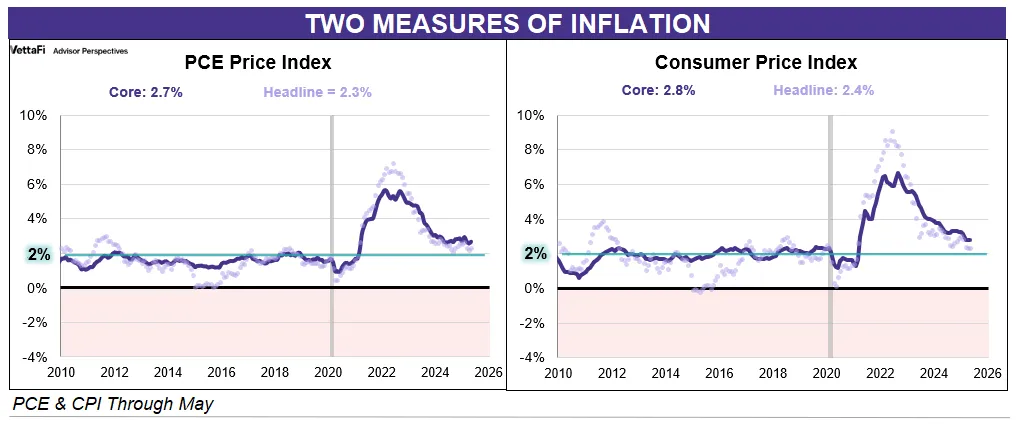
This uptick in Core PCE inflation suggests that underlying price pressures persist and remain above the Federal Reserve’s long-term target of 2%. The data, combined with a surprising contraction in US personal spending and income for May, presents a complex picture for policymakers. While softer consumer spending might typically lead to a more dovish stance from the Fed, the acceleration in core inflation could temper any immediate moves towards interest rate cuts.
Looking ahead, the next release for the Personal Income and Outlays report, which includes the PCE Price Index, will be on July 31, 2025, providing data for June 2025. Market participants will be keenly observing this next report for further clues on the inflation trajectory and its potential implications for the Federal Reserve’s monetary policy decisions, particularly regarding future interest rate adjustments.
Other Economic Indicators
- Personal Spending & Personal Income: The latest report on US personal spending and personal income for May 2025, released on June 27, 2025, by the U.S. Bureau of Economic Analysis (BEA), presented a notable downturn in consumer activity. Personal income experienced a decrease of 0.4% month-over-month (MoM), amounting to a decline of $109.6 billion. This marked the first monthly decrease in personal income since September 2021, falling short of market forecasts for a modest increase.
- Michigan Consumer Sentiment: The final reading of the University of Michigan Consumer Sentiment Index for June 2025, released on June 27, 2025, showed a significant rebound in consumer optimism. The index rose to 60.7, a notable increase from 52.2 in May. This marks the first improvement in consumer sentiment in six months and represents the largest monthly increase in over 30 years.
- Fed Chair Speech: On July 1st, 2025, Federal Reserve Chair Jerome Powell participated in a highly anticipated panel discussion at the European Central Bank (ECB) Forum on Central Banking in Sintra, Portugal. This appearance came just days after his semiannual testimony to Congress, and the central focus remained on the path of U.S. interest rates and the impact of tariffs on inflation. Powell reiterated the Fed’s “wait-and-see” approach regarding interest rate cuts, stating that while the U.S. economy remains in a “pretty good position” with a strong labor market, the Fed cannot commit to a July rate cut.
- S&P Manufacturing and ISM Manufacturing Index: S&P Global Manufacturing PMI for June 2025 saw a welcome return to growth for U.S. manufacturing production after three months of decline. The final reading of 52.9, up from May’s 52.0, indicated the strongest expansion since May 2022. This rebound was attributed to increased workloads driven by rising orders from both domestic and export customers. The data also showed a notable increase in employment within the sector, reaching its highest level since September 2022.
- JOLTS Job Opening for May and ADP Employment change for June: The JOLTS report for May 2025, released by the Bureau of Labor Statistics (BLS), showed an unexpected increase in job openings to 7.8 million, up from 7.4 million in April. This marks the second consecutive monthly increase in job vacancies and exceeded market expectations.
- Jobless claim: The latest data on U.S. jobless claims, released on July 3, 2025, for the week ending June 28, continues to paint a picture of a tight, albeit gently softening, labor market. Initial jobless claims fell by 4,000 to 233,000 for the week ending June 28th. This figure came in below analysts’ expectations of 240,000 and marks the lowest level for initial claims since mid-May. This suggests that the pace of new layoffs remains relatively subdued, indicating that businesses are largely retaining their employees despite ongoing economic uncertainties, including the impact of tariffs.
- Unemployment Rate & Non Farm Payrolls: Nonfarm Payrolls increased by 147,000 in June. This figure surpassed economists’ expectations, which had generally hovered around 110,000 to 120,000, and also marked a modest acceleration from May’s revised gain of 144,000 jobs. This robust job creation indicates that businesses are continuing to hire, even as concerns about trade tariffs and a potential economic slowdown persist
BTC Price Analysis
BTC has experienced a notable period of price movement over the past week, primarily influenced by a complex interplay of macroeconomic factors, geopolitical developments, and ongoing institutional adoption. After a volatile June which saw some dips due to heightened Middle East tensions, BTC has shown resilience and a renewed push towards higher levels, crossing the $108,000 mark and even briefly touching $110,000 this week.
Looking specifically at the past seven days (roughly from June 27th to July 3rd, 2025), BTC initiated the period with a recovery from earlier lows in June. While there was a correction on Monday, June 30th, and a continuation of that slight dip into July 1st, where it closed below $106,000, it quickly found support. By July 3rd, BTC was trading around $108,705, marking a significant gain from its weekly low. This upward momentum was attributed to a combination of factors, including easing geopolitical risks, positive statements from crypto asset managers like Bitwise, and continued institutional interest.
BTC Technical Analysis
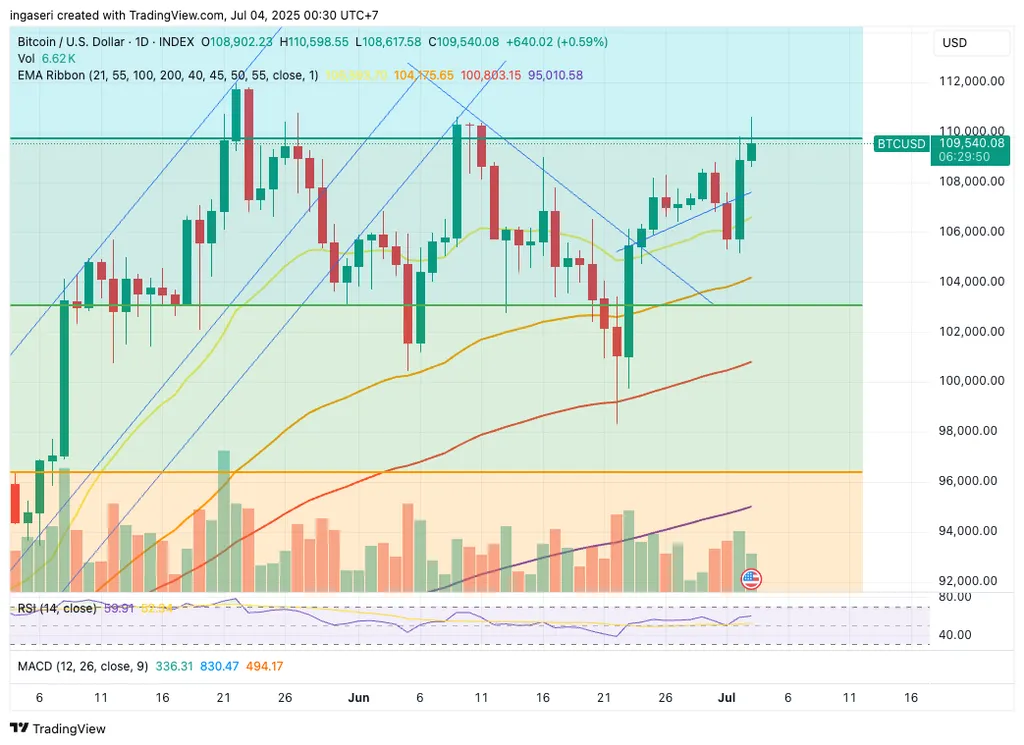
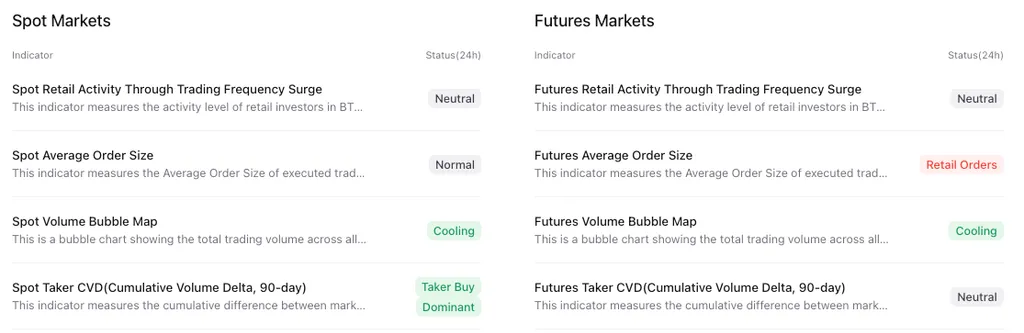
Technical analysis for the past week indicates a cautious but generally bullish sentiment. BTC has been trading above key Exponential Moving Averages (EMAs), such as the 20-day and 50-day EMAs, which are serving as strong short-term support levels. The Relative Strength Index (RSI) has been hovering around the neutral level, reflecting a period of indecision, but with upward momentum often being confirmed by “dip-buying” interest. However, resistance around the $110,000 to $112,000 mark has proven challenging to break decisively, with some analysts pointing to a lack of strong spot buying demand despite derivatives-driven pumps.
Overall, the past week for BTC has been characterized by a push higher, showing the cryptocurrency’s ability to rebound from geopolitical shocks and maintain its upward trajectory. While analysts like Bitwise are forecasting even higher targets for July and the rest of 2025 (some predicting $115,000 to $136,000 for July and even $200,000 by year-end), the immediate future will likely depend on whether BTC can gather sufficient spot demand to break above its current resistance levels. The market remains sensitive to macroeconomic news, including Federal Reserve policy and global liquidity, which will continue to shape BTC’s price action.
Altcoin Analysis
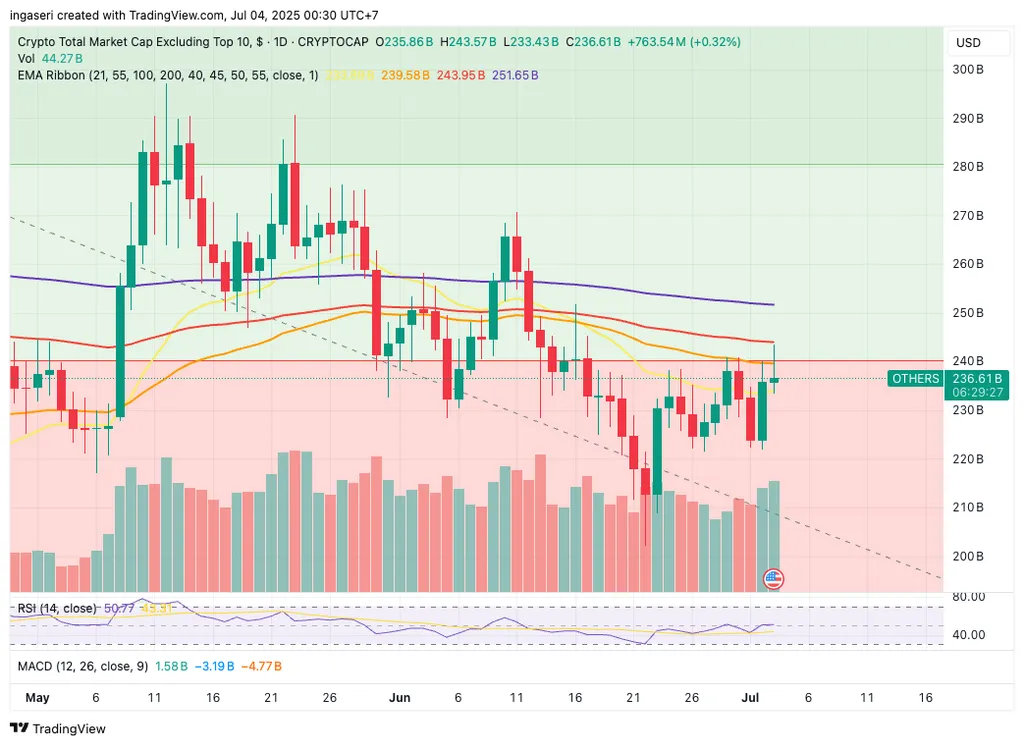
While BTC has been stealing headlines with its push towards new highs, the broader altcoin market has also shown a mix of resilience and strategic movements over the past week (roughly June 27th to July 4th, 2025). The total market capitalization excluding BTC recovered by nearly 10% last week, hinting that capital rotation from BTC into altcoins might be slowly beginning, or at least that altcoins are holding critical support levels.
ETH, as the leading altcoin, has mirrored some of BTC’s upward momentum while still facing its own set of pressures. Over the past week, ETH has seen gains of around 6-7%, trading around $2,550 to $2,600 as of July 3rd. Ethereum rebounded alongside the broader market, partly driven by an easing of geopolitical tensions. Technically, ETH has found support around $2,430 and is attempting to break above the $2,500 resistance. However, the path forward is not entirely clear, with some short-term technical pressure remaining. The ongoing anticipation surrounding Ethereum ETFs, despite recent delays by the SEC on staking ETFs, continues to fuel medium-to-long-term potential, with analysts like Bitwise CIO Matt Hougan predicting significant inflows into ETH ETFs later in 2025.
SOL has also exhibited positive price action, gaining approximately 7-8% over the last seven days, trading around $152-$155. A major catalyst for SOL’s performance this week was the historic launch of the U.S.-listed REX-Osprey Solana Staking ETF under the ticker $SSK, which recorded over $33 million in volume on its first day. This institutional product has injected new optimism into the Solana ecosystem. Technically, SOL has been holding above key support levels, with some analysts pointing to a “cup and handle” pattern forming, which could signal a potential push towards the $280-$300 range if the $140 level holds. Increased activity and institutional fund flows are crucial for a sustained uptrend, and the ETF launch is a significant step in that direction.
Other notable altcoins have shown varied performance. XRP has also seen gains of around 3-5% in the last seven days, trading around $2.25-$2.28, driven by increased volume and continued market interest. Ripple’s application for a U.S. national banking license is seen as a move towards greater regulatory clarity, which could further benefit XRP. BTC Cash has been a standout performer, revisiting levels not seen since December 2024, showing strong divergence and positioning itself as a notable option for short-term speculative trading. While meme coins like BONK have seen significant daily gains, the overall altcoin market remains sensitive to capital rotation dynamics from BTC and broader market sentiment, indicating that while there are signs of an “altcoin renaissance,” sustained growth will depend on broader market conditions and institutional interest beyond just BTC.
On-Chain Analysis
News About Altcoins
- First U.S. Solana Staking ETF Debuts With $12M Investment Amid Lukewarm Institutional Interest. The Rex-Osprey Solana + Staking ETF, the first U.S.-based exchange-traded fund offering exposure to Solana and staking rewards, launched with $12 million in initial investments and $33.6 million in trading volume on its first day. Despite being a milestone for crypto ETFs, institutional appetite appears limited, with trading volume falling short of expectations. Anchorage Digital, the ETF’s qualified custodian, handles asset custody and staking. Experts view this launch as a key step toward broader access to crypto investing in the U.S.
News from the Crypto World in the Past Week
- Dormant Bitcoin Wallets From 2011 Move $1.1B After 14 Years of Silence. Two Bitcoin wallets, each holding 10,000 BTC since April 2011, were reactivated this week after over 14 years of dormancy. Originally part of a 23,377 BTC transfer when Bitcoin was priced at just $0.78, these wallets moved their funds—now worth over $1.1 billion—to new addresses within 30 minutes of each other. The new addresses have not moved the funds since. Lookonchain suggests the same entity controls these two and possibly six other similar wallets. The reason for the sudden movement remains unknown, sparking speculation within the crypto community.
Cryptocurrencies Market Price Over the Past Week
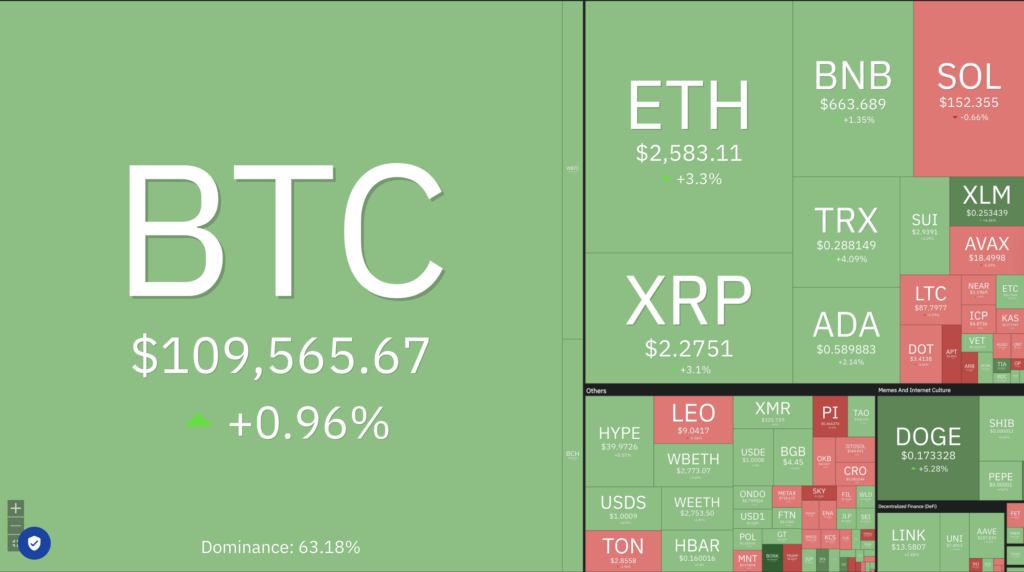
Cryptocurrencies With the Best Performance
- Bonk (BONK) +52.32%
- FLOKI (FLOKI) +14.10%
- Pudgy Penguins (PENGU) +9.62%
- Celestia +9.41%
Cryptocurrencies With the Worst Performance
- Jito -13.93%
- Aerodrome Finance (AERO) -12.76%
- Sei -12.33%
- Pi (PI) -12.00%
References
- Ander Beganski, Solana Staking ETF Bags $12M in Wall Street Debut, decrypt, accessed on 5 July 2025.
- Danny Park, Bitcoin OG wallets move billions of dollars in BTC after 14 years of dormancy, theblock, accessed on 5 July 2025.
Share
Related Article


See Assets in This Article





Bitcoin Price (24 Hours)
Market Capitalization
-
Global Volume (24 Hours)
-
Circulating Supply
-

