Tin Price Today, June 22, 2026: Correction from All-Time High

Jakarta, Pintu News – Global tin prices on June 22, 2026, are in the range of US$52,000 to US$53,000 per ton, correcting from the all-time high of US$57,960 per ton recorded on June 3, 2026. Despite the correction phase, the metal still shows an extraordinary year-on-year gain of 67%, driven by a persistent global supply deficit and surging demand from the technology industry, particularly artificial intelligence and semiconductors.
Drivers Behind Tin’s Price Surge in 2026
The significant rise in tin prices throughout 2026 is largely rooted in tight supply conditions in the world’s two major producing countries. Myanmar, one of the largest tin ore producers, continues to face production disruptions due to prolonged internal conflict. This situation has kept export volumes from that country well below normal capacity for several months.
On the other hand, Indonesia — the world’s second-largest tin producer — has also tightened its export policy. The Indonesian government has implemented more selective export permit regulations to ensure that the value-added benefits of tin production are captured domestically. This policy directly reduces the supply of processed tin available on the international market, creating sustained upward price pressure.
The combination of supply disruptions in Myanmar and Indonesia’s export policies has created a significant global supply deficit. This has served as a strong foundation for the tin price increases seen throughout the first half of 2026.
Price Correction Analysis: Is This Temporary?
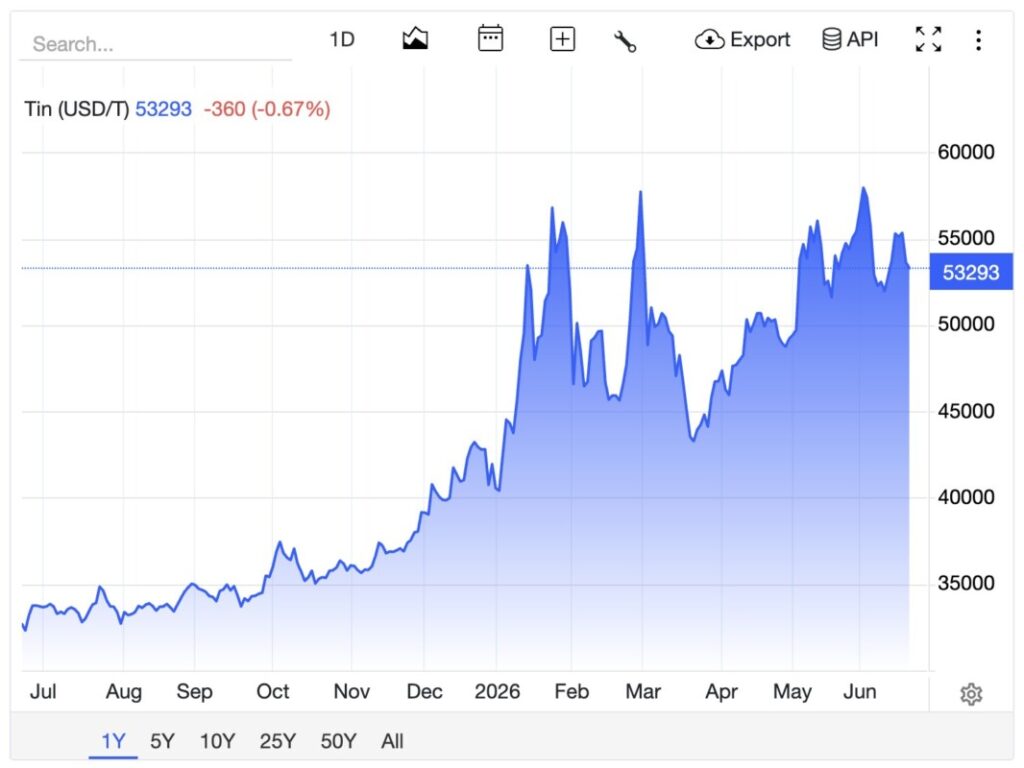
A price correction from the record US$57,960 down to the US$52,000–53,000 per ton range is a natural occurrence after a sharp rally. Technically, commodity markets typically enter a consolidation phase after reaching new highs, during which market participants engage in partial profit-taking.
Nevertheless, analysts view this correction as temporary, as long as the fundamental factors supporting higher prices have not changed significantly. Supply deficits from Myanmar and Indonesia are not expected to be resolved in the near term, while demand from the technology industry continues to trend positively.
Several risk factors to watch include: potential production normalization in Myanmar if the security situation improves, the possibility of weakening global demand due to economic slowdown, and changes in Indonesia’s export policy. Investors and industry players are advised to keep monitoring developments in these factors.
Read also: “10 Top Nickel Stocks in Indonesia“
Indonesia’s Position in the Global Tin Market
Indonesia holds a highly strategic position in the global tin market. The country is one of the world’s largest holders of tin ore reserves, with the Bangka Belitung Islands archipelago as the main production hub. PT Timah Tbk, as the state-owned tin company, is the dominant player in Indonesia’s tin supply chain.
The export permit tightening policy implemented by the Indonesian government is part of a broader mineral downstreaming strategy, similar to the policy previously applied to nickel. The government is encouraging the processing of tin into higher value-added products domestically before export, such as solder bars, tinplate, and tin-based chemical products.
This downstreaming strategy, while receiving mixed responses from international trading partners, is seen as strengthening Indonesia’s bargaining position in price negotiations and long-term supply contracts in the global market.
Read also: “Understanding Commodities: Definition, Types, and How to Invest“
Tin Price Outlook for the Second Half of 2026
Heading into the second half of 2026, the tin market is expected to remain volatile but with an overall upward price bias. The 67% year-on-year gain already recorded reflects a structural shift in tin’s supply-demand dynamics, not merely short-term speculation.
Key factors that will determine tin’s price direction going forward include: developments in Myanmar, the implementation of Indonesia’s export policy, the pace of global AI infrastructure investment growth, and macroeconomic conditions affecting overall electronics demand. Analyst consensus projects tin prices to move in the range of US$50,000 to US$60,000 per ton throughout the remainder of 2026.
For businesses that depend on tin supply, supply diversification strategies are becoming increasingly important amid this high volatility. For market observers, understanding the fundamental dynamics of this commodity is key to following industrial metals market developments more deeply.
Invest in Crypto Gold Starting from Rp11,000
As blockchain technology evolves, gold is no longer limited to physical forms like jewelry or bars — it can now be owned digitally through gold-backed crypto assets such as PAX Gold (PAXG) and Tether Gold (XAUT).
Crypto gold offers a more flexible, practical, and modern way to invest in gold compared to physical gold. Some benefits of investing in crypto gold on Pintu include:
- Start investing with a small amount, from just Rp11,000.
- Trade anytime, 24/7.
- Lower spread than physical gold.
- Safe and regulated — licensed and supervised by OJK.
- Easy to buy and can be automated on a schedule.
- Transfer between wallets quickly and conveniently.
Follow us on Google News for the latest updates on the crypto world and blockchain technology. Check Bitcoin price, USDT to IDR, and Nvidia stock price (tokenized) on Pintu Market.
As a secure crypto app, Pintu offers crypto trading and easy access to crypto gold investment. You can also check gold jewelry prices today and gold bar prices today to support your investment activities and portfolio diversification, and learn about crypto through Pintu Academy.
Download the Pintu crypto app on the Play Store or App Store now. Enjoy a web trading experience with advanced tools such as pro charting, various order types, and a portfolio tracker — exclusively on Pintu Pro.
*Disclaimer:
This content is intended to enrich readers’ information. Pintu collects this information from various relevant sources without any outside influence. Please note that past performance of an asset does not determine future performance projections. Crypto trading activities carry high risk and volatility; always do your own research and invest only what you can afford to lose. All Bitcoin buying and selling activities and other crypto asset investments are the reader’s responsibility.
References
- London Metal Exchange. “LME Tin – Official Prices“. London Metal Exchange. Accessed June 22, 2026.
- International Tin Association. “Tin Statistics and Market Data 2026“. International Tin Association. Accessed June 22, 2026.
- Reuters. “Tin prices retreat from record high amid supply concerns“. Reuters Commodities. Accessed June 22, 2026.