Main Advantages of Internet Computer (ICP)
The Internet Computer (ICP) has a number of distinctive advantages that set it apart from other blockchains:

Internet Computer is a decentralized blockchain network that aims to expand the ability of the public internet to run software directly. With this grand vision, Internet Computer aims to transform the internet from a mere medium of information to an open, efficient, and fully decentralized global computing platform. In this article, we will thoroughly discuss the Internet Computer, how it works, and the potential of ICP according to crypto traders.
Internet Computer is a decentralized blockchain cloud that can host full-stack applications, websites, and entire enterprise systems to run on the blockchain(on-chain). With this approach, all services benefit from the security and resilience offered by blockchain technology.
Internet Computer comes with the vision of creating a new, fully decentralized internet, where computing is no longer dependent on a handful of cloud service providers . Instead, the network is built from independent data centers around the world that are interconnected. In the long term, ICP aims to run on millions of computers globally, making it the new foundation for the next generation internet.
Unlike other networks that still rely on centralized servers to serve web content, Internet Computer (ICP) allows decentralized applications to serve websites directly from smart contracts. This innovation offers a unique approach to decentralized computing scalability.
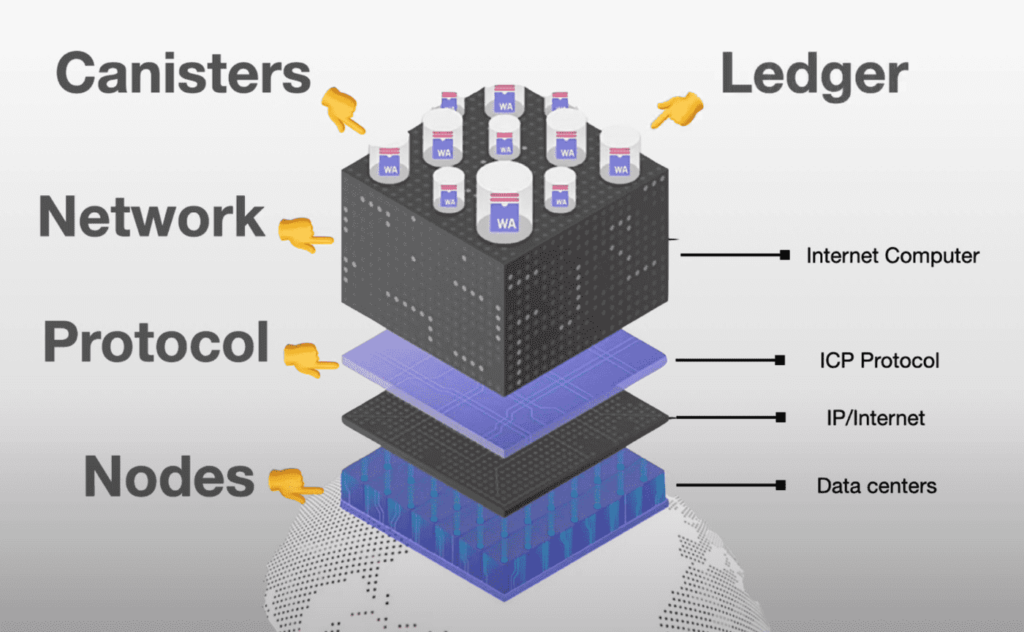
At the core of ICP’s architecture are its many subnets, where each subnet is its own blockchain. Despite running as independent blockchains, all subnets are interconnected and can communicate with each other, forming a unified, scalable network.
Just as traditional cloud infrastructure can be scaled by adding machines, ICP can also grow by adding new nodes to form new subnets. Each subnet can process transactions independently, allowing ICP to handle large transaction volumes withoutbottlenecks.
How do ICP chain-key signatures work? Each subnet uses chain key cryptography, which enables efficient message validation and maintains the integrity of the blockchain. In simple terms, each ICP subnet has one fixed public key.
The associated private keys are not stored on a single node, but are instead split intosecret shares and shared across nodes using threshold cryptography. This ensures that no single node controls the full key, thus improving security and scalability.
To verify the status and results of the system, users can simply check the digital signature against the fixed public key-without having to download or validate the entire block on the blockchain.
Messages from the blockchain can be verified by simply looking at the chain key signature. If the signature is valid, it means the message is authentic, unaltered, and comes from a secure subnet.
Benefits and Application of Chain-Key Technology:
NNS is an advanced decentralized autonomous organization (DAO) that manages the Internet Computer network. Running on the main subnet, NNS allows the community to participate in governance by staking ICP tokens and voting on proposals.
Approved proposals are automatically executed by the system, so that all nodes run the same version of the protocol and avoid hard forks. Since the chain key on the NNS subnet is fixed, nodes can verify the authenticity of the instruction by simply checking the digital signature.
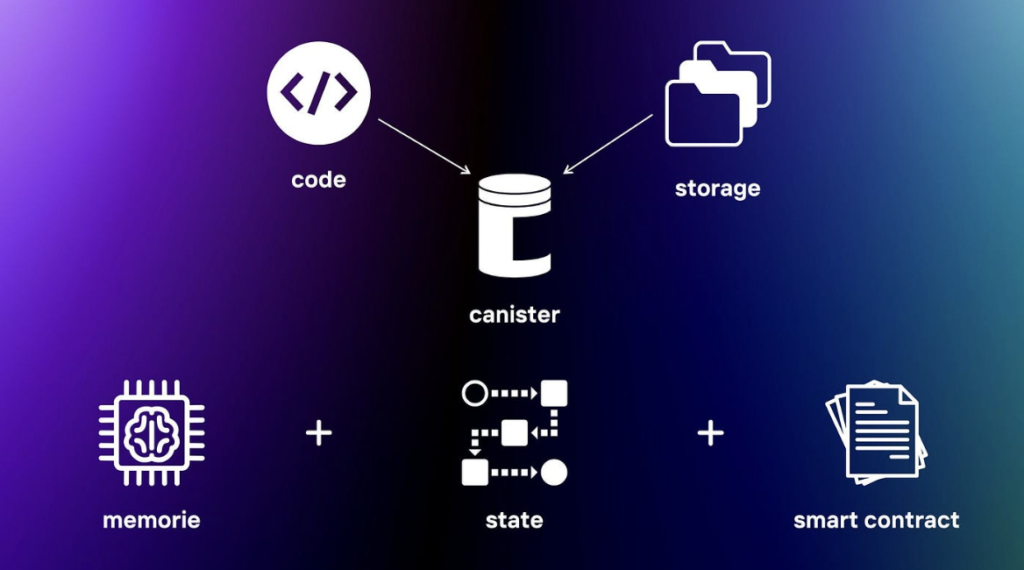
In ICP, smart contracts are called canisters. ICP uses WebAssembly (Wasm) as a virtual machine to run smart contracts, allowing developers to write code in popular programming languages such as JavaScript, TypeScript, Rust, Python and more. In fact, a single canister is powerful enough to run a full Ethereum Virtual Machine (EVM), making it possible to deploy Solidity-based smart contracts within the ICP ecosystem.
Canister can also handle HTTP requests, serve web assets, and interact with Web2 services, enabling the development of fully on-chainWeb3 applications – both frontend and backend. It can even send requests to services outside the ICP network.
Unlike smart contracts on Ethereum that execute sequentially in a single atomic transaction, ICP supports parallel execution. Smart contracts here are more like processes or microservices in traditional programming, and can run autonomously, including scheduling tasks automatically without the need for user interaction.
On most blockchains like Ethereum, users have to pay a transaction fee known as gas, which is the cost the network needs to execute transactions. Meanwhile, ICP applies a different approach called the reverse gas model. In this model, it is not the user, but the canister(smart contract) that pays the transaction execution fee.
Canister purchases units called cycles, which are units used to pay for resource consumption and computing. Cycles are similar to gas on Ethereum, but their price is stable because they are linked to a group of fiat currencies, and are purchased using ICP tokens.
The Internet Computer (ICP) has a number of distinctive advantages that set it apart from other blockchains:
Smart contracts in ICP can use a reverse gas model, where users do not have to pay any transaction fees. Instead, the fees are borne by the smart contract (canister), making the user experience completely cost-free.
ICP is the first blockchain capable of running as fast as a web application. Its transaction finalization time is just 1 second, which is about 900 times faster than Ethereum and 16 times faster than Solana. Decentralized applications (DApps) on ICP can even respond in about 200 milliseconds.
ICP smart contracts can handle HTTP requests and serve web assets such as HTML, JavaScript, and CSS. This means that web browsers can directly interact with canisters without the need for intermediaries such as public cloud services to display interfaces or web assets. Smart contracts can also communicate with Web2 services outside the ICP network.
Through chain-key cryptography technology, smart contracts in ICP can have their own cryptographic keys and sign transactions on other blockchains such as Bitcoin and Ethereum. This enables secure cross-blockchain interactions without the need to use bridges or third parties.
Thanks to its efficient architecture, ICP offers the cheapest storage fees among all blockchains, at around $5 per gigabyte per year.
| Aspects | Internet Computer (ICP) | Ethereum | Solana |
| Scalability & Performance | – Designed for web-scale performance – Process thousands of transactions per second – Sub-second finality – Use subnet (blockchain shard) + Chain Key for high scalability – Suitable for multiplayer games & fast transactions | – Limited throughput – Block time ±12 seconds – Finality can take several minutes – Prone to congestion during high traffic – Depends on Layer-2 (such as Polygon, Arbitrum) for scalability | – Theoretically 50,000+ polling stations – Very fast block time (~0.4 seconds) – In practice: hundreds of TPS – Suitable for real-time games – However, often suffers from stability issues and downtime under high load |
| Transaction Fees | – Use reverse gas model – Developer pays upfront costs (in cycles) – Users are not charged – Well suited for mass adoption | – Relatively high gas costs – Averages close to a dollar per transaction – Can spike to hundreds of dollars during peak times – Layer-2 helps lower costs, but main layer remains expensive | – Very low fees – Around $0.001 or less per transaction – Highly efficient for NFTs, asset transfers, & frequent game data updates |
Internet Computer uses a utility token also called ICP. This token has various important roles in the ICP ecosystem, including:
In addition to these four main uses, ICP tokens can also be used generally as a medium of exchange, for example to purchase NFTs, pay for service subscriptions, or other transactions within the Web3 ecosystem.
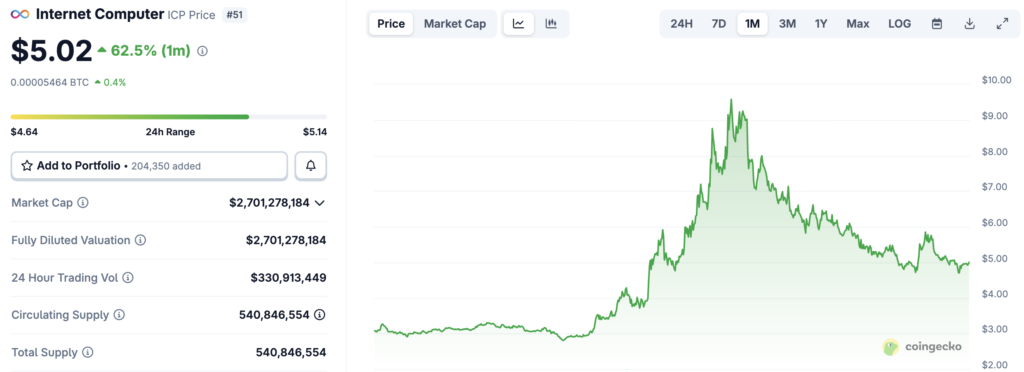
Over the past month, the price of the Internet Computer token (ICP) has seen a significant increase of 62.5%, rising to $5.02 from a low of $4.64 and peaking at $5.14. With a market capitalization of around $2.7 billion, ICP is now in 51st place in the global crypto asset ranking.
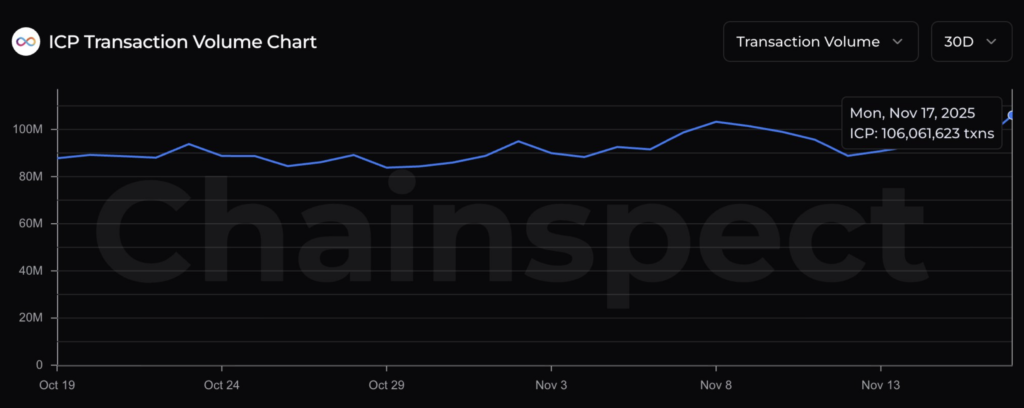
Furthermore, the ICP network continues to perform significantly with consistent growth in daily transaction volume. Based on data from Chainspect, the number of ICP daily transactions has now surpassed 106 million transactions on November 17, 2025.
Previously, ICP had set consecutive records starting from 98.6 million, then rising to 103 million, and now breaking the record again with 106 million transactions per day. This surge demonstrates the significant increase in usage of the Internet Computer ecosystem in a short period of time.
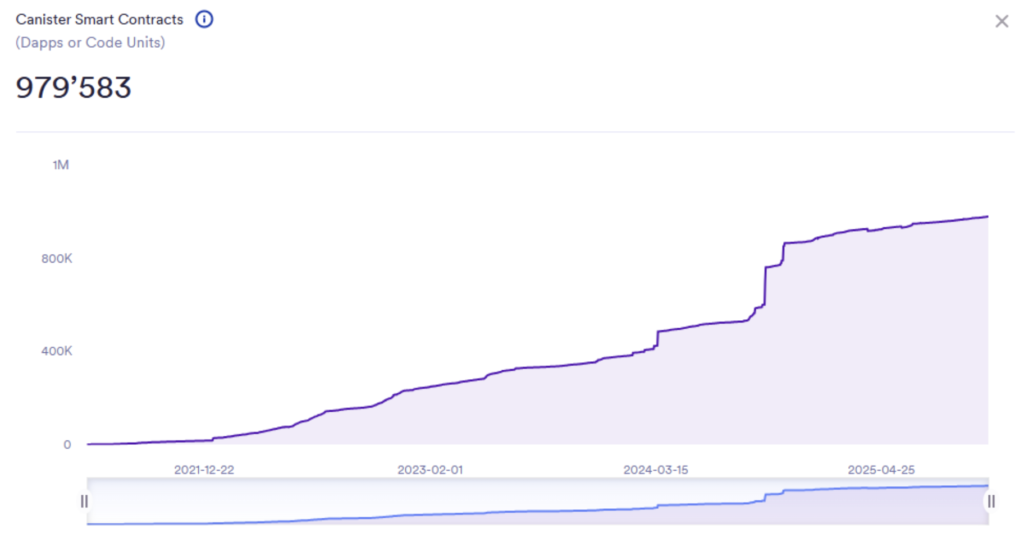
According to Coinpedia, the number of registered smart contract canisters – which can be considered one of the main indicators of network adoption – continues to show significant growth over the long term. Since January 2024, the number of canisters has increased from 372,968 to 979,583 to date. This reflects a 2.5-fold growth, confirming that the adoption of the Internet Computer Ecosystem (ICP) continues on a consistent basis.
In the second quarter of 2025, Internet Computer Protocol (ICP) caught the public’s attention again with the launch of Caffeine AI, an innovative platform that allows anyone to build Web3 applications instantly by simply writing down ideas in the form of ordinary sentences. In a post by X account @ICP_insider, Caffeine AI is described as a revolutionary AI assistant that functions as a developer, designer, and DevOps team all in one – all driven by artificial intelligence and running directly on top of the ICP blockchain.
Different from the usual website builder or chat-based code generator, Caffeine AI offers a number of excellent features:
Internet Computer (ICP) has been known as a crypto asset with unpredictable price movements. However, the activity surrounding the project is becoming more visible, and analysts are beginning to suggest that there are deeper reasons behind ICP’s return to positive momentum.
Discussions on various platforms point to the same narrative: while the general crypto market is sluggish, ICP is showing resilience that sets it apart from the overall market trend.
One observation that stood out came from Dao King, an analyst who highlighted that ICP was actually registering gains of up to 15% when many other large assets were experiencing declines. According to him, ICP is starting to stand out because the underlying technology shows real potential in the real world – in contrast to other projects that rely solely on hype.
Dao King described ICP as a project driven by real technology development, not speculation. He calls Internet Computer a third-generation (Gen3) blockchain with a market valuation that is still relatively small when compared to its technological capabilities, signaling that the project is starting to attract more serious attention.
Meanwhile, another analyst from ICP Insider provides a different point of view. He notes that ICP’s price movements are no longer overly affected by market downturns, as was often the case in the past. According to him, years of improvements from the development team and the foundation have started to change the basic structure of the asset.
He noted that ICP has moved past the phase where negative sentiment dominated, and is now beginning to forge a new identity built on consistent progress. He also noted that trading volumes have remained stable, and more importantly, the ICP network has now provided a tangible product that can actually be used by the public.
Internet Computer (ICP) is available and can be bought and sold at Pintu. Here are the steps on how to buy ICP at Pintu:
Overall, the Internet Computer (ICP) is a Layer-1 blockchain designed to transform the internet into a decentralized and verifiable computing platform. Through technologies such as smart contract canisters, Chain Key cryptography, and a unique consensus architecture, ICP enables smart contracts to not only store data and execute application logic, but also serve web content and interact directly with other networks such as Bitcoin and Ethereum-without the need for third-partytrusted bridges.
The ICP token itself has several important functions: it is used for network governance through the Network Nervous System (NNS) system, pays computing fees in the form of cycles, and provides incentives to participants who run and maintain the network infrastructure.
Canister is an advanced version of smart contracts that can store data, run application logic, and even serve web interfaces (HTML/CSS/JS) directly from the blockchain.
Execution fees in ICP are paid in cycles (units of computation). Developers fill their canisters with cycles in advance (from converted ICP tokens), so that end users are not charged-this model is called the reverse gas model.
Yes, ICPs can sign Bitcoin and Ethereum transactions directly from smart contracts using chain key cryptography, without the need for bridges or third parties.
Chain fusion allows ICP to interact directly with other blockchains such as Bitcoin and Ethereum natively and securely, without the risk of hacking that is common with bridges because no assets are stored in the intermediary.
Each subnet in ICP has a decentralized architecture controlled by NNS governance. Deterministic decentralization means all nodes follow the same rules and protocols ensuring consistency, reliability, and scalability without a single control center.
Disclaimer: All articles from Pintu Academy are intended for educational purposes and do not constitute financial advice.
Reference:
Share
Table of contents
See Assets in This Article
ICP Price (24 Hours)
Market Capitalization
-
Global Volume (24 Hours)
-
Circulating Supply
-