Uncovering MENA’s Role in Web3 and AI Adoption: A Technological Leap
Jakarta, Pintu News – The rapid growth of Web3 and artificial intelligence (AI) technologies in the Middle East and North Africa (MENA) region has attracted global attention. With strong regulatory support and strategic initiatives, MENA has the potential to become a leader in the ongoing digital revolution.
MENA’s Influence on Web3 Adoption
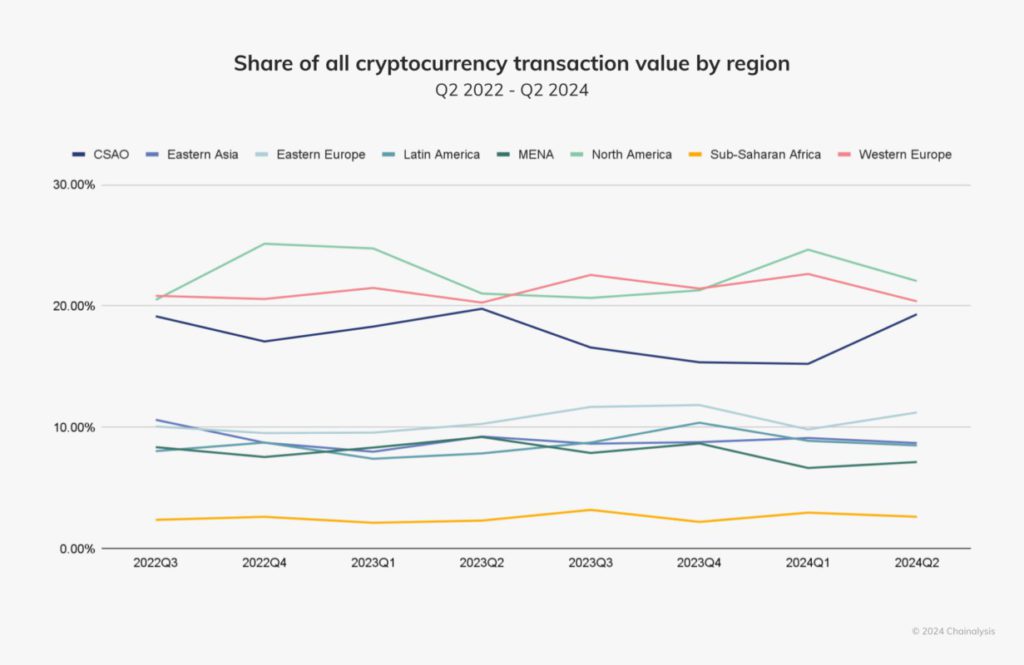
The MENA region has evolved into an important hub for Web3 development, driven by demographic, technological, and cultural factors. The region’s strong entrepreneurial spirit has created an enabling environment for the adoption of decentralized technologies. This is evident from the increasing number of startups, investors, and developers exploring Web3 and its diverse applications.
According to Chainalysis’ 2024 report, MENA ranks as the seventh largest crypto market in the world. From July 2023 to June 2024, the region recorded $338.7 billion in online crypto transactions, which represents 7.5% of all crypto transactions globally. While the overall size of the crypto market in MENA may be smaller compared to other regions, adoption within the country is significant.
Also Read: Arbitrum (ARB) Surges After Robinhood Entry: What Will Happen Next?
MENA’s Strategy Towards AI
The arrival of AI has prompted governments and businesses in the Middle East to recognize the global trend towards related advanced technologies. Countries like Qatar, Saudi Arabia and the United Arab Emirates (UAE) are considering their strategic position in this technological transformation.
A report from PricewaterhouseCoopers (PwC) predicts that AI could contribute up to $15.7 trillion to the global economy by 2030, with the Middle East accounting for 2% of the total global benefit, or around $320 billion. Saudi Arabia is expected to see the largest absolute gains from AI by 2030, with an addition of around $135.2 billion to its economy, or 12.4% of GDP.
Meanwhile, the UAE is expected to see the biggest impact as a percentage of GDP, approaching 14% of their 2030 GDP. For other GCC countries such as Bahrain, Kuwait, Oman, and Qatar, AI is expected to account for 8.2% of their GDP.
AI Development Initiatives in Saudi Arabia and UAE

In 2016, the government of Saudi Arabia launched Vision 2030, a program to promote economic, social, and cultural diversification. The strategic shift towards artificial intelligence and data-driven innovation is a key component of the country’s economic diversification efforts.
Saudi Arabia is making significant progress in AI with the aim of reducing dependence on oil by developing its advanced technology sector through targeted investment, infrastructure development, and workforce training. In 2017, the UAE launched its National Strategy for Artificial Intelligence, which aims to establish the country as a global leader in this field by 2031.
The UAE AI and Blockchain Council oversees this strategy, which impacts sectors such as education, energy, and tourism. The UAE has already started reaping the benefits of its AI initiatives. In April, Microsoft announced a $1.5 billion investment in G42, a technology holding company based in Abu Dhabi.
Conclusion
With a proactive approach to technological advancements and a strategic focus on Web3 and AI, MENA points to a future where the region will be an important architect in shaping the digital economy.
Also Read: Binance Attracts Investors After Bybit Hack, Funds Flow Increases Sharply!
That’s the latest information about crypto news today. Get more information about crypto academy from beginner to expert level only at Pintu Academy and enrich your knowledge about the world of crypto and blockchain.
Follow us on Google News to get the latest information about crypto and blockchain technology. Enjoy an easy and secure crypto trading experience by downloading Pintu Crypto via Google Play Store or App Store now.
Experience web trading with advanced trading tools such as pro charting, various order types, and portfolio tracker only at Pintu Pro. Click Register Pintu if you don’t have an account or click Login Pintu if you are already registered.
*Disclaimer
This content aims to enrich readers’ information. Pintu collects this information from various relevant sources and is not influenced by outside parties. Note that an asset’s past performance does not determine its projected future performance. Trading crypto carries high risk and volatility, always do your own research and use cold hard cash before investing. All activities of buying andselling Bitcoin and other crypto asset investments are the responsibility of the reader.
Reference
- BeInCrypto. Outlier Ventures CEO on MENA Web3 Adoption. Accessed on March 6, 2025
- Featured Image: Generated by AI
Latest News
© 2025 PT Pintu Kemana Saja. All Rights Reserved.
The trading of crypto assets is carried out by PT Pintu Kemana Saja, a licensed and regulated Digital Financial Asset Trader supervised by the Financial Services Authority (OJK), and a member of PT Central Finansial X (CFX) and PT Kliring Komoditi Indonesia (KKI). The trading of crypto asset futures contracts is carried out by PT Porto Komoditi Berjangka, a licensed and regulated Futures Broker supervised by BAPPEBTI, and a member of CFX and KKI. Crypto asset trading is a high-risk activity. PT Pintu Kemana Saja and PT Porto Komoditi Berjangka do not provide any investment and/or crypto asset product recommendations. Users are responsible for thoroughly understanding all aspects related to crypto asset trading (including associated risks) and the use of the application. All decisions related to crypto asset and/or crypto asset futures contract trading are made independently by the user.