

Meet Parallel EVM Technology: A New Revolution in Blockchain

Jakarta, Pintu News – Parallel Ethereum Virtual Machine (Parallel EVM) is an advanced development of the Ethereum Virtual Machine (EVM) commonly used in the Ethereum (ETH) blockchain. The main difference between Parallel EVM and the standard EVM lies in the way they process transactions and execute smart contracts. While the standard EVM processes transactions sequentially, Parallel EVM enables transaction processing in parallel, improving network efficiency and scalability.
Fundamental Differences with Standard EVM
In a standard EVM, each transaction is processed one after another, which can cause bottlenecks when the transaction volume increases. This method, although simple, often results in delays and higher costs. Parallel EVM, on the other hand, adopts a parallel processing approach, allowing multiple transactions to be processed simultaneously if they are not interdependent.
By processing transactions in parallel, Parallel EVM can increase throughput and reduce costs and delays. This is similar to the way Apache Spark processes data in parallel, where independent transactions and data can be processed asynchronously.
Also Read: XRP 2026 Price Prediction: Potential to Touch $10, Solana the Main Challenger? Here’s the Analysis!
Independent Block Data Processing Example
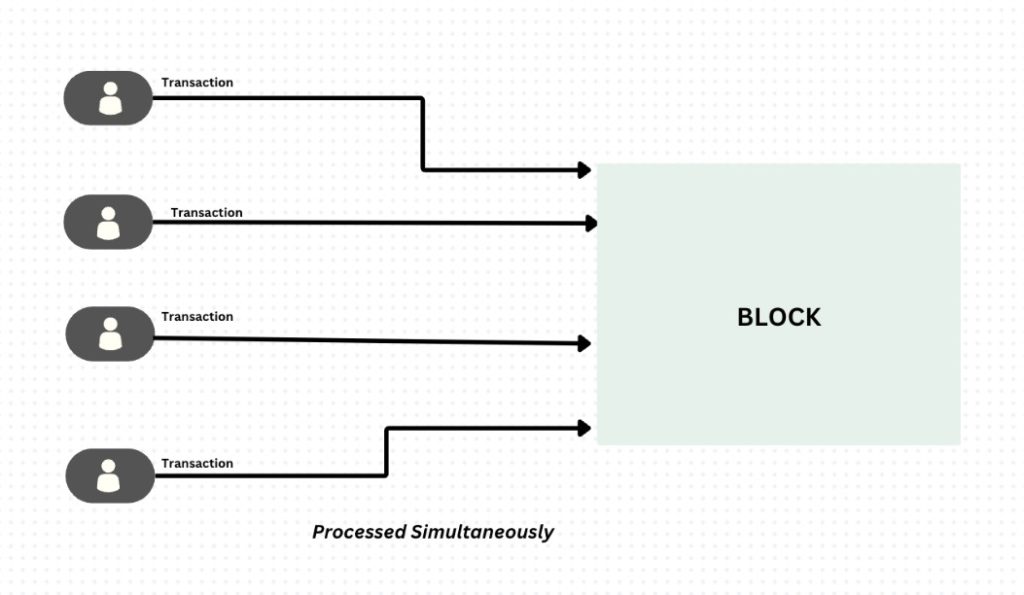
Suppose a block in the Ethereum (ETH) blockchain contains transactions A, B, and C. In standard EVM, these transactions will be processed sequentially. However, with Parallel EVM, Transactions A and C can be processed simultaneously as they are independent of each other and do not affect the outcome of Transaction B.
The ability to process Transactions A and C simultaneously with B, but in different threads, significantly speeds up the overall block processing time. This allows the network to handle larger transaction volumes more efficiently.
Impact on Blockchain Applications
Consider a decentralized exchange (DEX) that runs on the blockchain. In standard EVM, each trade must wait for the previous trade to complete, which can lead to slow trade execution. With Parallel EVM, many of these trades can be processed simultaneously, as long as they don’t interfere with each other.
This parallel processing results in faster trade execution, a more responsive DEX, and an overall better user experience. Parallel EVM represents a significant step in blockchain technology, addressing scalability issues by enabling more efficient transaction processing.
The Future of Blockchain with Parallel EVM
Parallel EVM promises significant improvements in the way blockchain handles transactions and smart contracts. By utilizing parallel processing, this technology opens up new possibilities for broader and more efficient blockchain applications. Going forward, many other networks are planning to integrate the Parallel EVM structure into their systems, signaling a new era in blockchain evolution.
Also Read: Dogecoin Rises 3.5% Amid Death Cross Pattern, What Does It Mean for the Crypto Market? (7/8/25)
Follow us on Google News to get the latest information about the world of crypto and blockchain technology. Check today‘ s bitcoin price, today’s solana price, pepe coin and other crypto asset prices through Pintu Market.
Enjoy an easy and secure crypto trading experience by downloading Pintu crypto app via Google Play Store or App Store now. Also, get a web trading experience with various advanced trading tools such as pro charting, various types of order types, and portfolio tracker only at Pintu Pro.
*Disclaimer
This content aims to enrich readers’ information. Pintu collects this information from various relevant sources and is not influenced by outside parties. Note that an asset’s past performance does not determine its projected future performance. Crypto trading activities are subject to high risk and volatility, always do your own research and use cold hard cash before investing. All activities of buying andselling Bitcoin and other crypto asset investments are the responsibility of the reader.
Reference
- Alibertay Solak. What is Parallel EVM. Accessed on August 7, 2025
Latest News
© 2026 PT Pintu Kemana Saja. All Rights Reserved.
The trading of crypto assets is carried out by PT Pintu Kemana Saja, a licensed and regulated Digital Financial Asset Trader supervised by the Financial Services Authority (OJK), and a member of PT Central Finansial X (CFX) and PT Kliring Komoditi Indonesia (KKI). Crypto asset trading is a high-risk activity. PT Pintu Kemana Saja do not provide any investment and/or crypto asset product recommendations. Users are responsible for thoroughly understanding all aspects related to crypto asset trading (including associated risks) and the use of the application. All decisions related to crypto asset and/or crypto asset futures contract trading are made independently by the user.