

5 Big Challenges Ethereum Is Facing Right Now
Jakarta, Pintu News – Ethereum (ETH), as one of the largest and most popular blockchain networks, is constantly trying to overcome various challenges that hinder its full potential.
While the technology has come a long way, the Ethereum ecosystem still faces major issues with scalability, user experience (UX), and interoperability.
This article will discuss the five biggest challenges Ethereum faces today according to Rostyslav Bortman, Founder at Ethereum Ukraine and how various updates and innovations can change its future direction!
1. Interoperability: Unifying L1 and L2
According to Cryptoslate, one of the biggest problems Ethereum faces is the lack of seamless interoperability between Layer 2 (L2) solutions. While bridges have helped users connect assets between different blockchains, the process is still awkward and time-consuming.
For example, intent-based bridges like Across can reduce the transaction time between Layer 1 (L1) and Layer 2 (L2) to 15 seconds for an L1 to L2 transfer, but this is only effective for highly liquid assets. Tokens like memecoins and other niche tokens are still difficult to bridge.
For Ethereum to be truly ready for mass adoption, interoperability must be part of the main infrastructure. This includes the ability to perform transactions across L2 and between L1 and L2 directly, which can improve efficiency and the overall user experience.
Projects such as Arbitrum, Optimism, and ZKSync are developing faster and cheaper solutions to this problem, and are expected to deliver better results by 2025.
2. User Experience (UX): Improving Usage of DApps and Wallets
Fragmentation among various L2 solutions is not the only bottleneck in the Ethereum ecosystem. Another UX (user experience) issue is the inability to batch transactions or sponsor gas fees for user wallets.
Previous attempts to introduce features such as EIP-4337 (Account Abstraction) failed due to the lack of a uniform standard. However, with the arrival of EIP-7702, this solution is getting closer to being implemented.
Also read: Ethereum (ETH) Could Reach $15,000 by the End of 2025? Here’s Fundstrat’s Prediction and Analysis!
EIP-7702 allows Externally Owned Accounts (EOA) wallets to temporarily function as smart contracts in a single transaction, which helps improve gas cost management and transaction efficiency.
This will allow users to make fewer transactions, pay fees in tokens other than ETH, and offer more flexibility in terms of security. The update is expected to be integrated in wallets and dApps within two months of Pectra’s launch.
3. Scalability: Limiting Load on Ethereum
Scalability issues are a major challenge Ethereum has faced since its inception. While Layer 2 (L2) solutions have been an important part of increasing network capacity, improved efficiency at Layer 1 (L1) is still needed.
By improving execution efficiency in L1, the entire Ethereum system, including rollups and other solutions, can benefit directly.
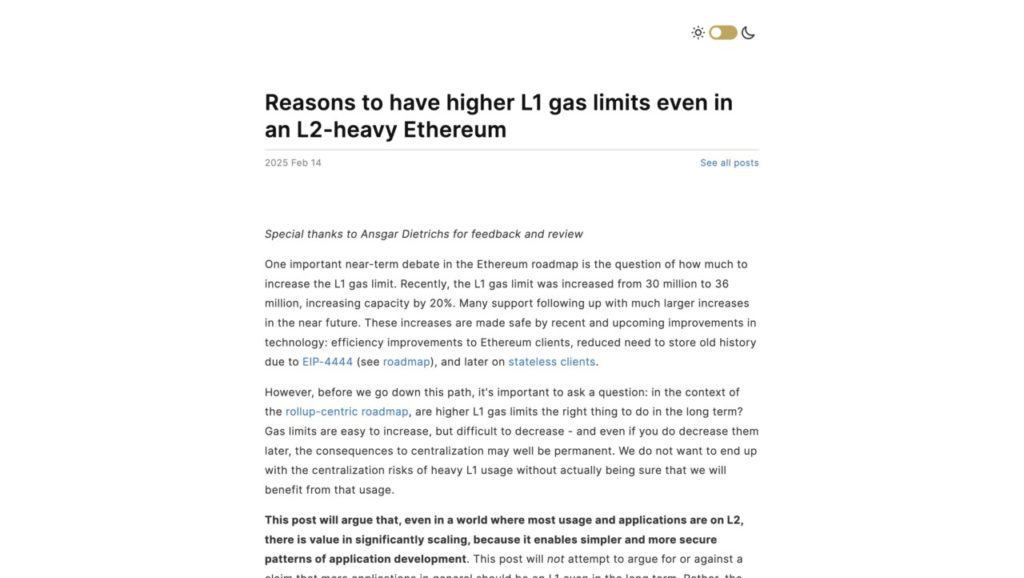
In his blog post, Vitalik Buterin, the founder of Ethereum, emphasized the importance of improving efficiency on L1 to optimize rollup performance.
The plan to double the number of DA (Data Availability) blobs from 3 to 6 on Pectra is expected to reduce congestion and increase transaction speed, even reaching the level of speed that Solana has.
Validium, a solution for off-chain data processing, is also being considered as a way to accelerate network scalability.
4. Gas Fee Reduction: Making Ethereum More Affordable
One of the big obstacles to Ethereum adoption is high gas fees, especially during periods of high activity. Users often have to wait or pay high fees just to complete basic transactions.
While Ethereum has attempted to address this issue with Layer 2 solutions, such as Optimistic Rollups and ZK-Rollups, affordable gas fees remain a key goal.
With recent updates and feature enhancements like Pectra, Ethereum plans to increase transaction capacity without sacrificing low fees. This will help reduce the burden of gas fees and make Ethereum more attractive to a wider range of users, including those participating in DeFi or NFT applications.
Read also: SEC Acknowledges Invesco Galaxy’s Filing for Solana ETF, Here Are the Details!
5. Security and Protection Against Attacks
Ethereum is constantly striving to ensure that the network and users remain safe from potential attacks. As the complexity and number of decentralized applications (dApps) built on Ethereum increases, so does the potential for attacks.
Protection against attacks such as rug pulls and honeypots is becoming more important, as many projects have the potential to deceive users.
Projects on Ethereum have begun developing security-enhancing features, such as anti-rug pull and reorg protection mechanisms, to keep user assets safe. While these efforts are still in the development stage, increased security is key to Ethereum’s future sustainability.
Conclusion
Ethereum is undergoing major changes that have the potential to address challenges such as interoperability, user experience, scalability, gas fees, and security.
Updates like EIP-7702 and Pectra are important steps towards realizing mass adoption. Although there are many challenges to overcome, Ethereum is on track to revolutionize the cryptocurrency and blockchain world.
That’s the latest information about crypto. Follow us on Google News to get the latest information about the world of crypto and blockchain technology. Check today‘ s bitcoin price, today’s solana price, pepe coin and other crypto asset prices through Pintu Market.
Enjoy an easy and secure crypto trading experience by downloading Pintu crypto app via Google Play Store or App Store now. Also, get a web trading experience with various advanced trading tools such as pro charting, various types of order types, and portfolio tracker only at Pintu Pro.
*Disclaimer
This content aims to enrich readers’ information. Pintu collects this information from various relevant sources and is not influenced by outside parties. Note that an asset’s past performance does not determine its projected future performance. Crypto trading activities have high risk and volatility, always do your own research and use cold cash before investing. All activities of buying and selling bitcoin and other crypto asset investments are the responsibility of the reader.
Reference:
- Cryptoslate. Fixing Ethereum’s biggest problems. Accessed August 17, 2025.
- Featured Image: Generated by AI
Latest News
© 2026 PT Pintu Kemana Saja. All Rights Reserved.
The trading of crypto assets is carried out by PT Pintu Kemana Saja, a licensed and regulated Digital Financial Asset Trader supervised by the Financial Services Authority (OJK), and a member of PT Central Finansial X (CFX) and PT Kliring Komoditi Indonesia (KKI). Crypto asset trading is a high-risk activity. PT Pintu Kemana Saja do not provide any investment and/or crypto asset product recommendations. Users are responsible for thoroughly understanding all aspects related to crypto asset trading (including associated risks) and the use of the application. All decisions related to crypto asset and/or crypto asset futures contract trading are made independently by the user.