

Here are 5 Cryptos Traders Short the Most When Fear Takes Over the Market
Jakarta, Pintu News – As the fear index in the crypto market rises, selling pressure and speculation on price drops soar. In such a situation, many traders start taking short positions on certain crypto assets, hoping to profit from the price drops they expect to see.
However, not all assets get the same treatment. Some cryptos are prime targets for shorts due to high volatility, strong negative sentiment, or a lack of positive short-term catalysts.
This article will discuss the 5 crypto assets that are most often shorted when the fear index surges.
Bitcoin (BTC)
Bitcoin (BTC) is often a “leading indicator”: when fear strikes, many investors decide to sell or “short” BTC first, which then triggers a wave of declines in the crypto market at large.
Read also: Bitcoin Price Prediction: Path to $100,000 Could be Hindered by Short-Term Holder Action
The Bitcoin liquidation chart over the period November 5 to December 10 shows an interesting pattern, especially on the Short side. On several occasions, traders who took positions against the market trend – i.e. Short positions – experienced large amounts of liquidation, signaling an unanticipated upward price shock.
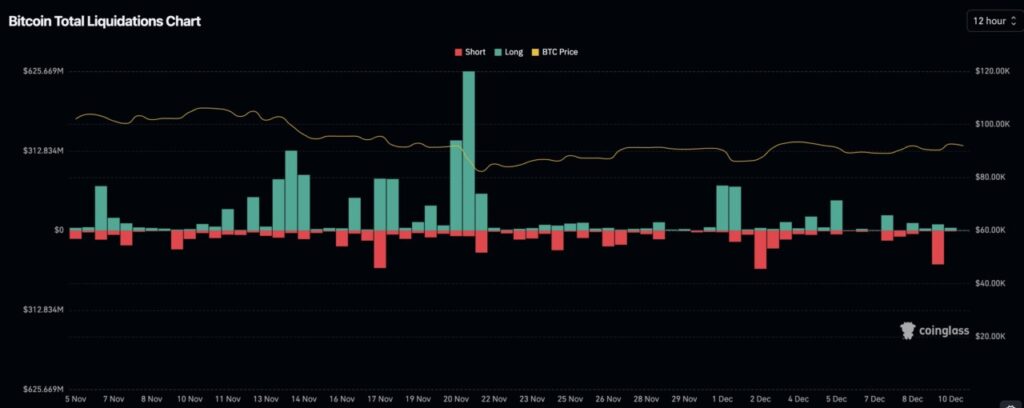
The peak of Short liquidation pressure occurred around November 17 and 21, with a very significant volume of Short liquidations, even approaching or exceeding $300 million in a single day. This reflects that many traders expected the price of Bitcoin to fall, but instead saw a sharp price spike, forcing their positions to be liquidated.
In the past few days (around early to mid-December), although the volume of Short liquidations appeared to be more moderate compared to late November, this pressure pattern still continued. Short liquidation has continued to dominate over Long in recent 12-hour periods, signaling that traders are still likely to be mis-positioned against the direction of the current market trend.
Ethereum (ETH)
As the largest altcoin after Bitcoin, Ethereum (ETH) is also often affected by the wave of selling when the fear index drops.
During the period from November 5 to December 10, the Ethereum market showed quite intense dynamics, especially in terms of liquidation of short positions. Several key moments showed that traders who bet on a fall in the ETH price became the main victims when the price turned up.
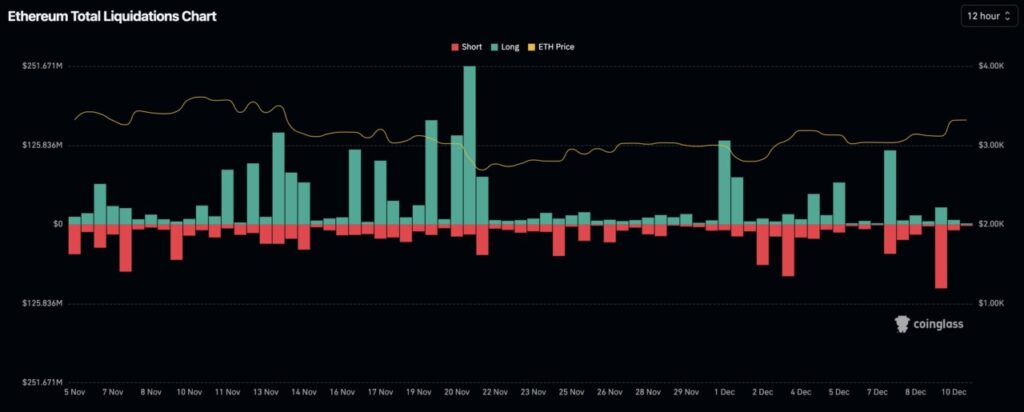
Significant Short liquidations occurred around November 7-8, November 14, and November 21-22, where liquidation volumes reached tens to hundreds of millions of dollars.
The peak came around December 1, when a spike in ETH prices led to a surge in Long and Short liquidations, but particularly pressured Short positions, which were wiped out in large amounts. This suggests that many traders mispredicted the direction of the trend, anticipating a correction that didn’t happen.
Solana (SOL)
Solana (SOL) is one of the large and liquid crypto assets that corrects sharply when the crypto market goes down. This makes it a frequent short target, especially in times of panic selling or when leverage is used massively.
During the period from November 5 to December 10, the Solana market exhibited a fairly active liquidation pattern, with the liquidation of Long positions dominating nominally. However, the pressure on Short positions remained consistent and relevant – especially when SOL prices experienced unexpected spikes.
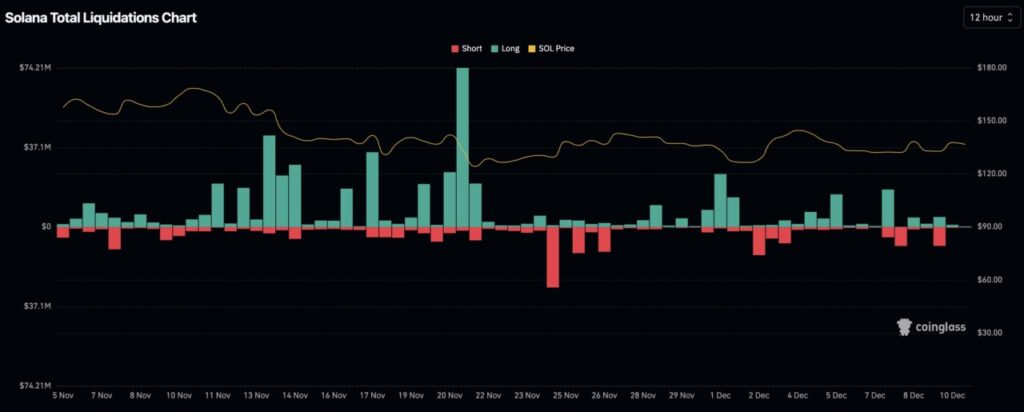
The peak of liquidations occurred around November 21, where the volume of Long liquidations jumped sharply to close to $74 million, followed by significant pressure on Short positions. This reflects the highly volatile market conditions, where rapid and unexpected price movements triggered liquidations on both sides.
However, throughout the chart we see that Short liquidations consistently appear almost every day, albeit on a smaller scale than Longs. This indicates that most traders are still trying to challenge Solana’s uptrend by going Short – and paying a heavy price as the SOL price stays above $100 for most of the period.
Read also: XRP Weekly Chart Shows Tight Consolidation Ahead of Wave 3 Target!
XRP
When crypto markets are shaken and negative sentiment is rampant, XRP (XRP) often corrects along with other large assets, attracting the attention of short traders.
During the period from November 5 to December 10, the XRP market showed a highly volatile liquidation pattern, with large spikes from both the Long and Short sides at several key moments – reflecting the volatile market conditions and uncertainty of trend direction.
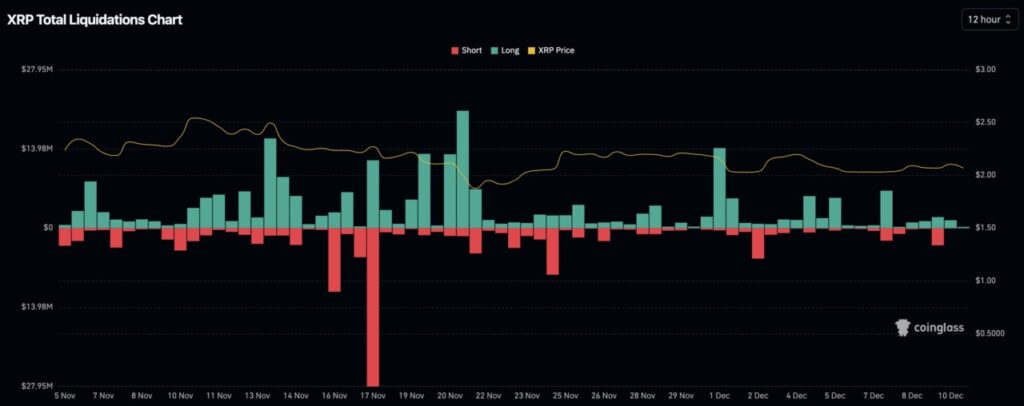
The most notable peak occurred on November 17, when the liquidation of Short positions reached an extreme point, signaling that many traders expected the price of XRP to fall sharply, but instead it turned significantly higher.
This surge was followed by a wave of long liquidation a few days later, indicating a sharp reversal in price direction that surprised both sides of the market.
The Long side dominated liquidation volumes at several other key junctures, most notably around November 13-14 and November 21-22, with volumes touching the $13 million-$27 million range, suggesting that expectations of XRP price increases were often overly optimistic. However, Short positions were also not spared from pressure, especially when XRP price showed a sudden recovery.
Dogecoin (DOGE)
Due to its characteristics as a “meme coin” – with high volatility and influenced by sentiment & speculation – Doge (DOGE) is often a big target when fear hits the market.
Throughout the period from November 5 to December 10, the Dogecoin market showed relatively active dynamics, with the liquidation of Long positions being more dominant in nominal terms, but the liquidation of Short positions has also started to increase in recent days.
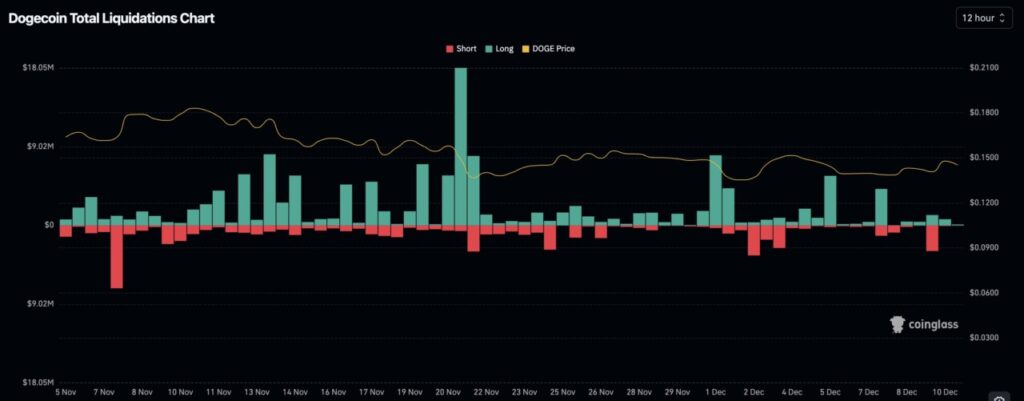
The chart shows that a huge spike in liquidations occurred on November 21-22, where the volume of Long liquidations jumped to close to $18 million. This reflects that many traders took long positions in expectation of a price increase, but failed to anticipate the sharp correction that ensued, resulting in their positions being exposed to mass liquidation.
Another notable moment occurred on December 1, where Long liquidation surged again, followed by an equally high volume of Shorts – indicating that the market was experiencing extreme two-way movements, and both sides were equally exposed to risk.
That’s the latest information about crypto. Follow us on Google News to get the latest crypto news about crypto projects and blockchain technology. Also, learn crypto from scratch with complete discussion through Pintu Academy and stay up-to-date with the latest crypto market such as bitcoin price today, xrp coin price today, dogecoin and other crypto asset prices through Pintu Market.
Enjoy an easy and secure crypto trading experience by downloading Pintu crypto app via Google Play Store or App Store now. Also, get a web trading experience with various advanced trading tools such as pro charting, various types of order types, and portfolio tracker only at Pintu Pro.
*Disclaimer
This content aims to enrich readers’ information. Pintu collects this information from various relevant sources and is not influenced by outside parties. Note that an asset’s past performance does not determine its projected future performance. Crypto trading activities have high risk and volatility, always do your own research and use cold cash before investing. All activities of buying and selling bitcoin and other crypto asset investments are the responsibility of the reader.
Latest News
© 2026 PT Pintu Kemana Saja. All Rights Reserved.
The trading of crypto assets is carried out by PT Pintu Kemana Saja, a licensed and regulated Digital Financial Asset Trader supervised by the Financial Services Authority (OJK), and a member of PT Central Finansial X (CFX) and PT Kliring Komoditi Indonesia (KKI). Crypto asset trading is a high-risk activity. PT Pintu Kemana Saja do not provide any investment and/or crypto asset product recommendations. Users are responsible for thoroughly understanding all aspects related to crypto asset trading (including associated risks) and the use of the application. All decisions related to crypto asset and/or crypto asset futures contract trading are made independently by the user.