

Alert! More than 5% of Emails Contain Malicious Content

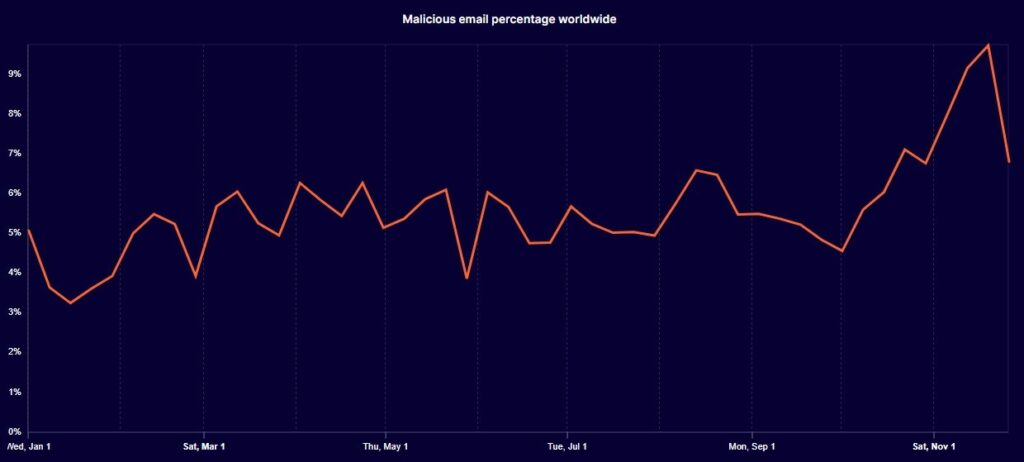
Jakarta, Pintu News – According to a recent report from Cloudflare, an internet infrastructure giant, more than 5% of emails sent worldwide contain malicious content. By November 2025, this figure rises sharply to almost 10%. These malicious emails include those that can lead to the theft of credentials, data or money.
High Percentage of Malicious Emails
Cloudflare, in its annual report, found that about 5.6% of the total global email traffic analyzed was identified as malicious. This means that more than one in every twenty emails contained content that could harm its users. In November, this proportion of malicious emails increased to almost one in ten, indicating a significant increase in risk.
In the context of cybersecurity, email is still one of the main methods of spreading threats. According to research conducted by Barracuda, a cybersecurity company, about a quarter of all HTML attachments in the emails they analyzed contained malicious code. This shows that cybercriminals are constantly evolving their methods for spreading malware and phishing.
Also Read: 7 Reasons Ripple (XRP) Prediction to Break $100 is the Global Crypto Talk
The dominance of misleading links
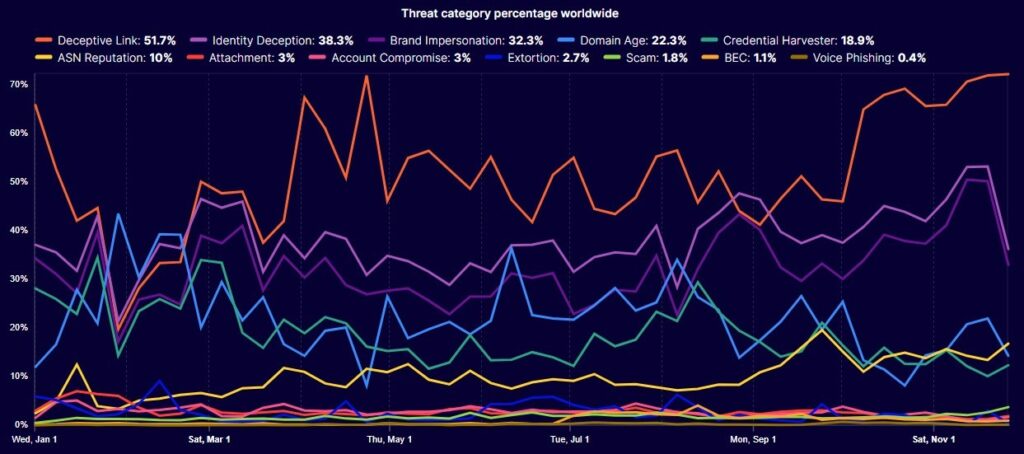
More than half of the malicious emails analyzed by Cloudflare contain misleading links. These links are often designed to trick email recipients into clicking and entering fake websites that can steal personal or financial information. 52% of malicious emails contained this type of threat, making it the largest threat category.
In addition, identity fraud is also increasing, from 35% in 2024 to 38% in 2025. Criminals use look-alike domains or mimic trusted domain names to deceive victims. They also use display name tricks to make emails appear to come from legitimate sources.
Risks for Crypto Investors
These findings are particularly relevant for crypto investors, given that phishing attacks targeting crypto traders, investors, and executives have increased in both complexity and frequency. Crypto phishing links can be particularly costly as once victims are trapped, they are often unable to recover lost funds.
These attacks not only impact individuals but also trust in the crypto ecosystem as a whole. A total of 12% of malicious PDF attachments analyzed by Barracuda were Bitcoin (BTC)-related scams, indicating that cybercriminals are actively targeting this digital asset.
Conclusion
Awareness and caution in managing email is essential to protect yourself from cyber threats. Users should be on the lookout for suspicious emails and use security solutions that can detect and block malicious content before it causes harm.
Also Read: Bitcoin Stuck Below $94,000: When Will Price Recovery Happen?
Follow us on Google News to get the latest information about crypto and blockchain technology. Check Bitcoin price today, Solana price today, Pepe coin and other crypto asset prices through Pintu Market.
Enjoy an easy and secure crypto trading experience by downloading Pintu crypto app via Google Play Store or App Store now. Also, get a web trading experience with various advanced trading tools such as pro charting, various types of order types, and portfolio tracker only at Pintu Pro.
*Disclaimer
This content aims to enrich readers’ information. Pintu collects this information from various relevant sources and is not influenced by outside parties. Note that an asset’s past performance does not determine its projected future performance. Crypto trading activities are subject to high risk and volatility, always do your own research and use cold hard cash before investing. All activities of buying andselling Bitcoin and other crypto asset investments are the responsibility of the reader.
FAQ
Q1: What percentage of malicious emails are found by Cloudflare in 2025?
A1: Cloudflare found that 5.6% of global email by 2025 contains malicious content.
Q2: What are the biggest threat categories in malicious emails according to Cloudflare?
A2: Misleading links are the biggest threat category, with more than half (52%) of malicious emails containing these types of links.
Q3: How have phishing attacks increased against the crypto community?
A3: Phishing attacks against the crypto community have increased in both complexity and frequency, targeting crypto traders, investors, and executives.
Q4: What is the impact of crypto phishing links?
A4: Crypto phishing links can cause significant financial losses as victims are often unable to recover the funds they have lost.
Q5: What advice do you have to protect yourself from malicious emails?
A5: It is important to always be on the lookout for suspicious emails and use security solutions that can detect and block malicious content.
Reference
- Cointelegraph. Over 1 in 20 emails are malicious, warns internet giant Cloudflare. Accessed on December 17, 2025
Latest News
© 2026 PT Pintu Kemana Saja. All Rights Reserved.
The trading of crypto assets is carried out by PT Pintu Kemana Saja, a licensed and regulated Digital Financial Asset Trader supervised by the Financial Services Authority (OJK), and a member of PT Central Finansial X (CFX) and PT Kliring Komoditi Indonesia (KKI). Crypto asset trading is a high-risk activity. PT Pintu Kemana Saja do not provide any investment and/or crypto asset product recommendations. Users are responsible for thoroughly understanding all aspects related to crypto asset trading (including associated risks) and the use of the application. All decisions related to crypto asset and/or crypto asset futures contract trading are made independently by the user.