

5 Interesting Facts 83% Crypto Phishing Loss Drop: 2025 New Data

Jakarta, Pintu News – Losses due to phishing in the cryptocurrency ecosystem have significantly decreased in 2025, according to the latest data from a blockchain security platform. This phenomenon is seen as one of the notable changes in the digital risk landscape, although experts emphasize that the threat has not completely disappeared and instead shows a shift in modus operandi. The following information is based on reports cited from NewsBTC and the Scam Sniffer study.
Phishing Losses Drop to 83 Percent
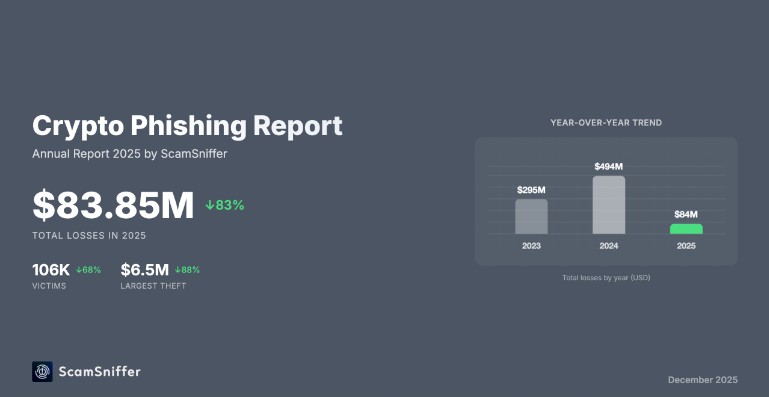
Losses caused by phishing attacks in the crypto market in 2025 dropped sharply to around USD83.85 million, equivalent to around Rp1.4 trillion based on an exchange rate of 1 USD = Rp16,708. This figure reflects a decrease of about 83 percent compared to the 2024 period which reached nearly USD494 million. This data is taken from the annual analysis report by blockchain security platform Scam Sniffer.
This decline has also been accompanied by a decrease in the number of victims. The number of wallets affected by phishing attacks is estimated to have dropped by 68 percent year-over-year. This information shows that not only has the total value of losses decreased, but also the scale of the impact on users as a whole.
Analysts attribute this decline to security improvements in various crypto services as well as increased user awareness of the risks of fake signatures and misleading smart contract approvals.
Also Read: 2026, a Hopeful Year for Solana: Predictions and Challenges
Number of Major Incidents Drops Significantly
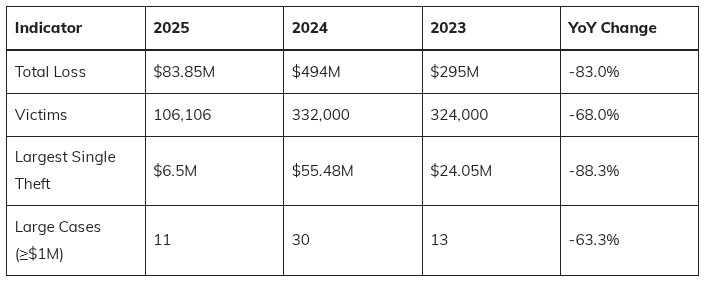
The number of incidents that caused major losses – i.e. more than USD1 million per occurrence – also saw a sharp decline throughout 2025. Only 11 cases with losses of more than USD1 million were recorded, significantly lower than the 30 major incidents in 2024. This data points to a shrinking trend of large-sized attacks in the crypto phishing landscape.
The decline in the number of major incidents is attributed to a strategic shift by criminals to smaller-scale but more frequent attacks. This makes the impact per incident lower and harder to detect in the early stages.
As a result, the average loss per victimized user also dropped sharply, reflecting a shift in phishing mode to more dispersed schemes.
Modes of attack are changing, not disappearing
Despite the decrease in total losses, the report confirms that phishing threats have not disappeared from the crypto world. Criminals are known to have started using new strategies that target a larger number of victims with lower losses per incident.
Still common types of attacks include the misuse of digital signatures such as Permit and Permit2, where users unknowingly give consent that enables theft. This technique remains one of the highest loss vectors despite the relatively lower total value per incident.
The report also shows that EIP-7702, a new signature method that emerged after certain network upgrades, was also used in complex attack incidents.
Correlation Between Market Activity and Phishing Attacks
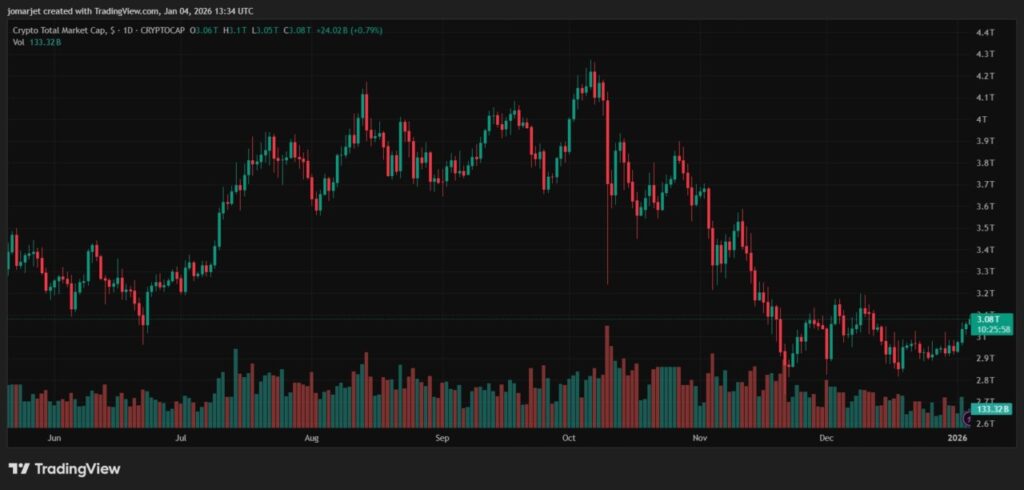
The data shows that phishing losses follow the cycles of crypto market activity in general, including periods when the price of Ethereum (ETH) and other cryptocurrencies are rallying. During the third quarter of 2025, when ETH rallied quite strongly, total phishing losses peaked for that period, at around USD31 million.
This shows that phishers tend to capitalize on periods of increased transaction activity and market interest. When more users are active, the chances of a successful attack increase, resulting in higher total losses in the quarter.
This relationship between market activity and phishing loss rates is important for cryptocurrency users to understand in order to adjust their vigilance according to market conditions.
Changing Offender Behavior and Crypto Security Challenges
As attackers’ strategies change, the security community and digital wallet developers also continue to improve protection features. For example, many wallets now provide alerts when signature approval requests appear suspicious.
But experts warn that the drop in statistics doesn’t mean the risk has disappeared completely. Successful phishing attacks still occur and continue to adapt to technology trends and user behavior.
Cryptocurrency users are still advised to always review consent requests before signing any interactions with smart contracts, and utilize additional security tools such as on-chain monitoring to mitigate evolving threats.
What it Means for Crypto Users in 2026
The dramatic drop in total losses from phishing attacks shows that education efforts and security technologies are having a real impact on reducing risk for digital asset owners.
But as perpetrators continue to change tactics, crypto users need to remain vigilant and keep up with the latest security practices. This vigilance is important to reduce the chances of becoming the next target, especially during periods of active markets or price rallies.
Also Read: Ripple’s (XRP) Big Breakthrough in 2026, Are You Ready?
Follow us on Google News to get the latest information about crypto and blockchain technology. Check Bitcoin price today, Solana price today, Pepe coin and other crypto asset prices through Pintu Market.
Enjoy an easy and secure crypto trading experience by downloading Pintu crypto app via Google Play Store or App Store now. Also, get a web trading experience with various advanced trading tools such as pro charting, various types of order types, and portfolio tracker only at Pintu Pro.
*Disclaimer
This content aims to enrich readers’ information. Pintu collects this information from various relevant sources and is not influenced by outside parties. Note that an asset’s past performance does not determine its projected future performance. Crypto trading activities are subject to high risk and volatility, always do your own research and use cold hard cash before investing. All activities of buying andselling Bitcoin and other crypto asset investments are the responsibility of the reader.
Reference:
- NewsBTC. Crypto Users Lose Far Less To Phishing As Losses Drop 83% – Details. Accessed January 5, 2026.
Latest News
© 2026 PT Pintu Kemana Saja. All Rights Reserved.
The trading of crypto assets is carried out by PT Pintu Kemana Saja, a licensed and regulated Digital Financial Asset Trader supervised by the Financial Services Authority (OJK), and a member of PT Central Finansial X (CFX) and PT Kliring Komoditi Indonesia (KKI). Crypto asset trading is a high-risk activity. PT Pintu Kemana Saja do not provide any investment and/or crypto asset product recommendations. Users are responsible for thoroughly understanding all aspects related to crypto asset trading (including associated risks) and the use of the application. All decisions related to crypto asset and/or crypto asset futures contract trading are made independently by the user.