

The Impact of Trump’s 10% Global Tariff on Bitcoin and Crypto Markets: What to Know?
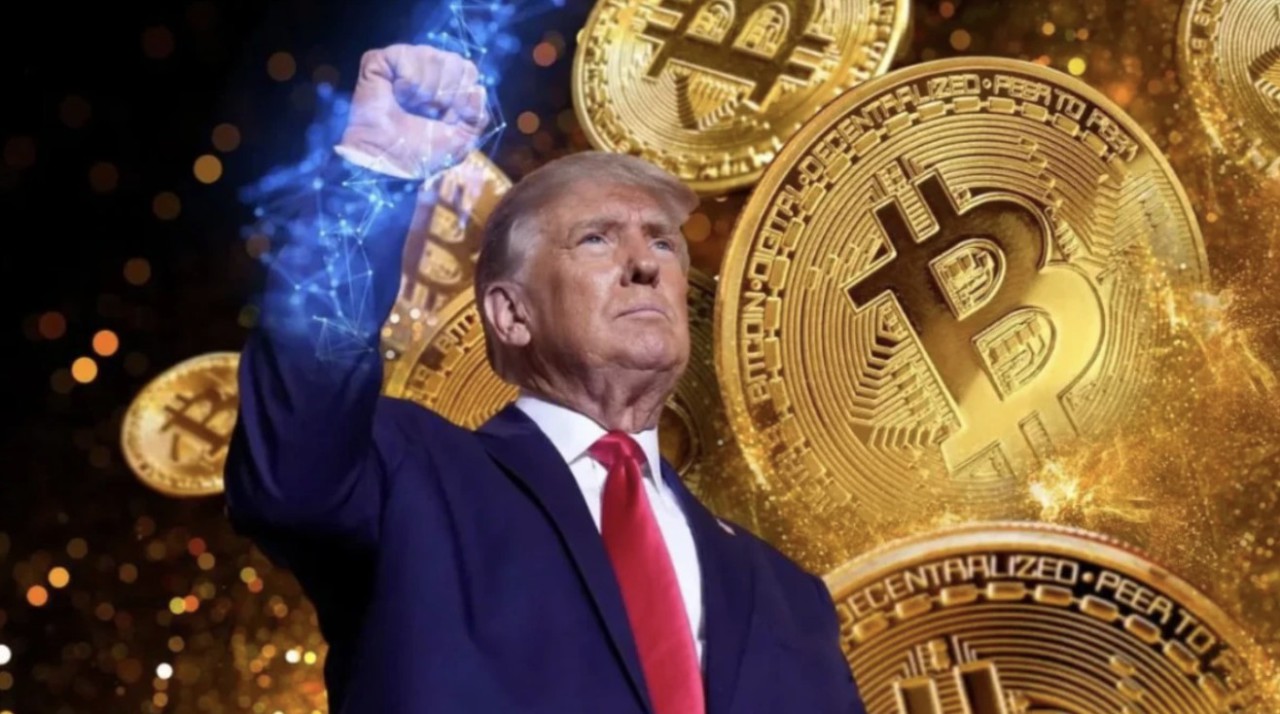
Jakarta, Pintu News – On Friday (20/2), President Donald Trump announced a global tariff of 10% on all imported goods effective immediately, just hours after the US Supreme Court struck down his emergency tariffs under theInternational Emergency Economic Powers Act (IEEPA).
In a heated White House briefing, Trump called the Court’s decision “ridiculous”. He promised to move forward with alternative trade measures.
Trump and Supreme Court Dissent
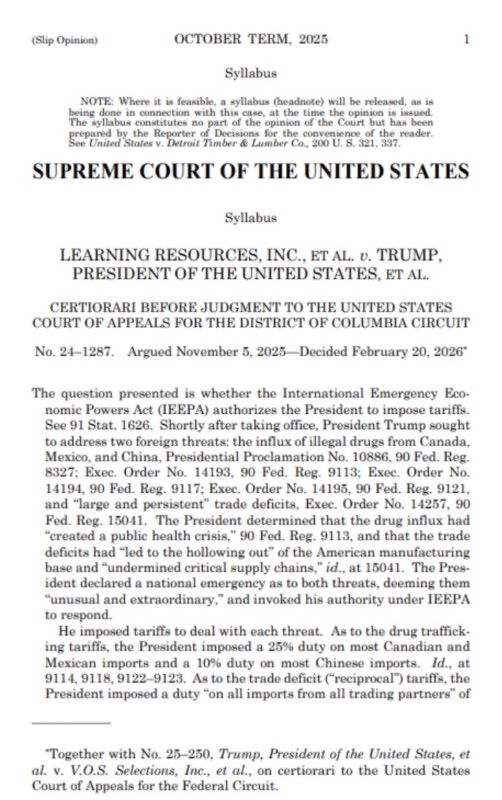
According to reports, US President Trump emphasized that the existing national security tariffs under Section 232 as well as trade practice tariffs under Section 301 will remain fully in place. He also signed a new order imposing a 10% global tariff under Section 122 of theTrade Act.
Read also: Bitcoin Vs Gold: Which Asset Will Explode in 2026?
Previously, the court had strongly warned that only Congress has the authority to set import duties.
In its majority opinion, the Court noted that in the 50-year history of IEEPA, “no president has ever used it to impose any tariff, let alone one of this magnitude.” The Court also emphasized that under Article I of the Constitution, the power over tariffs rests with Congress.
Crypto Market Volatile Reaction to Trump Tariffs
Markets crept up on Friday, but concerns remain looming. Bitcoin (BTC) ended the day at around $67,700, up about 1.2%. The main altcoin, Ethereum (ETH), also increased approximately 1.5% to $1,970.
Several other major altcoins also posted gains: XRP (XRP) rose 1.5%, BNB (BNB) gained 3.2%, and Solana (SOL) jumped 4%, lifting the total crypto market capitalization to around $2.4 trillion.
A number of indicators point to a jittery market mood. Around $180 million of leveraged crypto positions were liquidated in a 24-hour period on Friday. More than $67.9 million of the total liquidation came from Bitcoin short positions alone.
Crucially, institutional fund flows showed a downward trend. The spot Bitcoin ETF recordedoutflows of around $165.8 million, while the Ethereum ETF recorded outflows of $130 million on the day.
In other words, many investors have quietly started to secure their profits(taking chips off the table). David Hernandez, a crypto fund specialist, observed that this phenomenon highlights the “highly democratic and borderless nature of crypto.” Investors tend to seek globalhedges when macro uncertainty spikes.
Some retail market participants are even starting to turn to altcoins, as seen by the small inflows into Solana and XRP funds. However, the overall picture remains clear: traders are feeling nervous. One market analyst noted that volatility is currently “on the rise compared to levels observed over the past 12 months.”
Risk-On vs Risk-Off: Sentiment Shift
Tariff-related news usually triggers risk-off sentiment, and crypto markets are not immune to this. In traditional markets, the Supreme Court decision briefly sent the dollar lower and US stocks higher as investors anticipated cheaper import costs.
However, Trump’s talk of retaliatory tariffs strengthened the dollar and pressured the stock market. Crypto traders are well aware of this dynamic: historically, a strengthening dollar and fund flows tosafe-haven assets can erode demand for Bitcoin and altcoins.
In fact, on Friday, gold and silverrallied to new highs amid the turmoil. Many crypto investors are taking a pragmatic view: “Protectionist policies that weaken the dollar’s hegemony could accelerate interest in decentralized alternatives in the medium to long term,” suggests Marcin Kazmierczak, COO of blockchain platform RedStone.
In other words, some see an upside; if the dollar weakens, it might encourage more users to switch to crypto.
However, most market observers are more focused on the short-term impact, with analysts warning of “renewed confusion” in global markets as they await Trump’s next move. Friday’s court ruling and tariff news reminded crypto investors of last October’scrash, when Trump’s first tariff announcement triggered massive liquidation.
As one strategist, Denny Galindo of Morgan Stanley, put it, the“flash crash” was like “a needle breaking a leverage bubble.” Many traders are worried that we may be facing round two: another unwanted shock to already thin liquidity.
Miners and Hardware: Caught in the Middle of a Conflict Vortex
These tariff changes have hit those in mining and physical hardware production the hardest. The crypto mining industry itself is built on a highly centralized supply chain.
Read also: Ethereum Price Weakens to $1,800 Today: ETH Threatened to $1,300?
Three Chinese companies-Bitmain, Canaan, and MicroBT-currently produce more than 90% of Bitcoin mining rigs worldwide. Over the past year, US authorities have imposed a basic tariff of around 10% on many imported technologies (plus an additional 20% specifically for equipment of Chinese origin).
In response, Chinese companies have begun setting up factories on US soil to avoid import duties. However, the transition process is far from complete.
Many US miners and smaller companies still import most of their machinery and components from Asia. As Kadan Stadlemann, CTO at crypto platform Komodo warns, “US miners will still buy rigs from China and will be hit by higher import costs in the short term.”
Others in the industry echoed the same sentiment. Guand Yang, CTO of Conflux Network, noted that the trade war is already triggering “structural, not just surface, changes to the bitcoin supply chain.”
Today, mining in North America is booming (about 30% of global mining now takes place here), but the fact is that more than 90% of rigs still come from China.
This imbalance leaves US miners feeling vulnerable, especially if tariffs continue to creep up. Each additional percentage point of tax on new ASIC machines will effectively slash miners’ already thin profit margins.
Many small operators, who have invested millions of dollars in data center equipment and power, now face a difficult question: can they survive with even higher costs? For them, this is not just an abstract policy debate, but a real issue of job and capital survival.
Voices of the Crypto Industry and Community

Voices from different sectors of the economy paint a picture of mixed emotions. Business leaders outside of the crypto sector welcomed the Supreme Court decision for the legal certainty it brought.
Steve Lamar, head of the apparel trade association, urged a return to “predictable and reliable trade policies” to ease the “heavy tariff burden” on American industries and families.
Michael Wieder, founder of baby gear manufacturer Lalo, said that although the court only required a different legal path for rate-setting, “we’ve been waiting for this… so it’s definitely a good day.” Many had hoped for an easing of the burden.
However, the Twitter universe-and traders‘ chat rooms-werequickly filled with doubts. Business lawyer Steve Orava notes that in the short term, “uncertainty” is a winner.
Both pro and con tariffs, he said, all agree that certainty about tariff levels is what most businesses need. Crypto executives voiced similar concerns; the suddenwhiplash has left them uneasy.
One blockchain investor commented, “Every time they say ‘mission accomplished,’ something new comes up. It’s very tiring for those of us who are building companies.”
On the crypto side, some are trying to find asilver lining. David Hernandez of crypto ETF issuer 21Shares observes that crypto’s “highly democratic and borderless nature” allows it to act as ahedge when national policies clash.
In fact, some other community members have begun to speculate that if tariffs weaken the US dollar over time, Bitcoin might benefit.
“Protectionist policies that could potentially undermine the dollar’s hegemony could accelerate interest in decentralized alternatives,” argues RedStone’s Kazmierczak. This is a long-term view – but one shared by some traders who bet on Bitcoin as a hedge against inflation or instability.
Even so, these long-term expectations provide little solace to those on the front lines. One crypto miner we contacted (requesting anonymity) summed it up succinctly: “We love volatility, but not when politicians are playing chess with our livelihood.”
Crypto at a Crossroads After Court Ruling on Tariffs
For countless users, from day traders glued to price charts to engineers managing data centers, the day marked yet another shock in an already tumultuous year.
The Supreme Court provided a legal victory for those tired ofpolicy whiplash, but the swift backlash from Trump ensured markets had to remain vigilant.
Friday’s events put the crypto world at another crossroads. On the one hand, advocates of the rule of law are cheering that no branch of government is above the law.
On the other hand, the market-especially the crypto market-is bracing for more volatile price movements(whipsaw action). Ultimately, investors and crypto miners are left balancing between fear and hope.
They worry that higher fees and renewed uncertainty could dampen demand. However, they are also hopeful that in a world of growing economic nationalism, Bitcoin and other assets can prove their worth as decentralized alternatives.
Follow us on Google News to stay up to date with the latest in crypto and blockchain technology. Check Bitcoin price, usdt to idr and tokenized nvidia stock price through Pintu Market.
Enjoy an easy and secure crypto trading and crypto gold investment experience by downloading the Pintu crypto app via Play Store or App Store now. Also, experience web trading with advanced trading tools such as pro charting, various order types, and portfolio tracker only at Pintu Pro.
*Disclaimer
This content aims to enrich readers’ information. Pintu collects this information from various relevant sources and is not influenced by outside parties. Note that an asset’s past performance does not determine its projected future performance. Crypto trading activities are subject to high risk and volatility, always do your own research and use cold hard cash before investing. All activities of buying and selling Bitcoin and other crypto asset investments are the responsibility of the reader.
Reference:
- CoinRepublic. How Trump’s 10% Global Tariffs Could Impact Bitcoin and Crypto Markets. Accessed on February 24, 2026
Latest News
© 2026 PT Pintu Kemana Saja. All Rights Reserved.
The trading of crypto assets is carried out by PT Pintu Kemana Saja, a licensed and regulated Digital Financial Asset Trader supervised by the Financial Services Authority (OJK), and a member of PT Central Finansial X (CFX) and PT Kliring Komoditi Indonesia (KKI). Crypto asset trading is a high-risk activity. PT Pintu Kemana Saja do not provide any investment and/or crypto asset product recommendations. Users are responsible for thoroughly understanding all aspects related to crypto asset trading (including associated risks) and the use of the application. All decisions related to crypto asset and/or crypto asset futures contract trading are made independently by the user.