

6 Facts about Paraguay Mining Bitcoin from 30,000 Seized Rigs

Jakarta, Pintu News – Paraguay is preparing to run a state-run Bitcoin (BTC) mining program, taking advantage of a rare combination: thousands of confiscated mining rigs and surplus hydroelectricity. The initiative puts energy policy at the foundation of crypto strategy, with the aim of turning confiscated assets and cheap electricity capacity into revenue streams in the cryptocurrency ecosystem.
1. ANDE Signs MoU for Country-Based Bitcoin Mining
Paraguay’s state-owned power company, Administración Nacional de Electricidad (ANDE), signed a Memorandum of Understanding (MoU) with infrastructure company Morphware. The partnership is aimed at establishing a state-run and owned Bitcoin mining program. In this scheme, ANDE will be the main operator, while Morphware will act as a technical advisor since ANDE has no experience mining Bitcoin.
The program leverages two domestic resources: confiscated mining rigs and low-cost hydroelectricity from the Itaipú hydropower plant. Instead of exporting electricity at low prices under the terms of the agreement, a portion of the supply will be diverted to ANDE-controlled mining facilities. For crypto investors, this is interesting because it reflects the country’s efforts to capture added value from energy, rather than simply selling it as a commodity.
Also Read: Czech Central Bank seeks 100 tons of gold reserves, Bitcoin (BTC) is still under consideration
2. Initial Phase: 1,500 Seized Rigs Installed in Utility Building Near Substation
In the pilot phase, about 1,500 confiscated miners will be installed in ANDE’s utility building near the substation. Such a location can be converted into a basic mining facility with relatively clear technical requirements: ventilation, transformers, distribution units, and adequate metering systems. With this approach, ANDE can utilize existing infrastructure to reduce implementation time and costs.
From a cryptocurrency perspective, the decision to place rigs near substations is also about transmission efficiency and operational control. The closer the power source and distribution point, the easier it is to manage power loads, monitoring, as well as metering compliance. It also reduces the room for “unmetered connection” practices that were previously a major problem.
3. Background of Seizures: Raids Since the Beginning of 2024 Against Illegal Mining
This decision follows a series of nationwide raids since early 2024, when ANDE cracked down on illegal and unmetered high-voltage power connections used by miners. Many of the rigs that will be used in the program were seized in the May-June 2024 period, when inspections were tightened in mining hotspot areas. In the context of public policy, this reorients law enforcement from simply cutting off illegal practices to monetizing confiscated assets.
One highlighted example occurred in Salto del Guairá, when ANDE seized 2,738 rigs after discovering high loads without meters. The loss of stolen electricity was estimated to be around 1.1 billion guaraní per month, which is said to equate to around $146,000 or around Rp2,470,174,000 per month (exchange rate 1 USD = IDR16,919). This scale helps explain why the country sees mining as not just a crypto issue, but also an energy governance issue.
4. Total stock of confiscated rigs nears 30,000 units
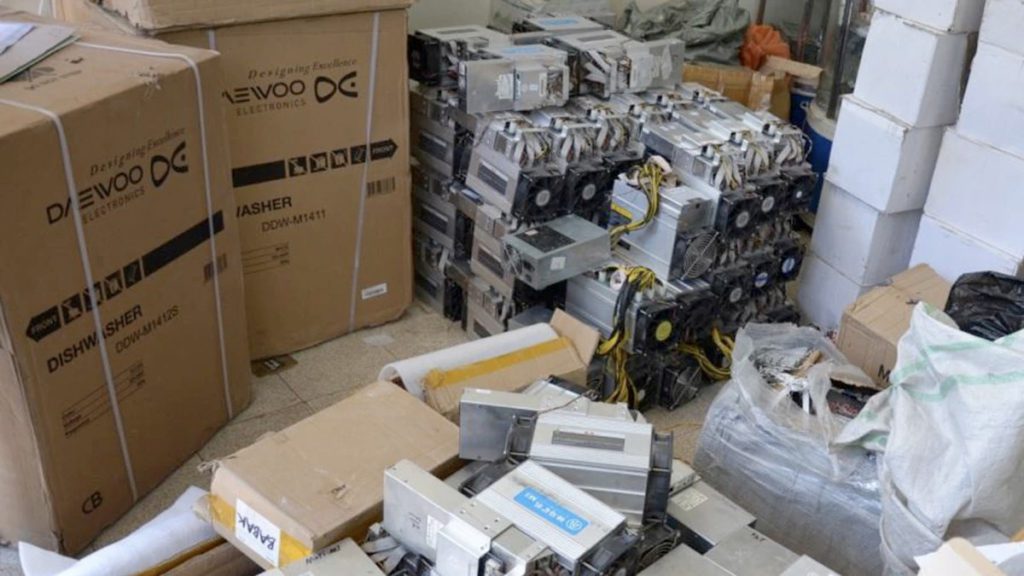
The accumulation of various crackdowns makes the stock of confiscated ASICs said to be close to 30,000 units. In the crypto market, this number of rigs is enough to establish a meaningful hash rate capacity if fully operational and supported by a stable electricity supply. However, the size of the stock also brings challenges: rig quality varies, maintenance needs are not small, and energy efficiency is a determining factor in profitability.
For those of you reading this as novice investors, the important point is the difference between “having a rig” and “having an efficient mining operation.” Bitcoin mining profitability is highly dependent on electricity costs, machine efficiency (watts per terahash), network difficulty, and treasury management strategies. Therefore, Morphware’s role as a technical advisor is a key element in the execution of this cryptocurrency program.
5. New Model: Countries Convert Energy Surplus into Hash Rate
The ANDE-Morphware program adopts an emerging pattern: keep energy in the country, build infrastructure, then let the country capture the upside of Bitcoin production. In the logic of the crypto market, when domestic energy is abundant and cheap, mining can be positioned as an “industrial load” that converts energy into digital assets. This is different from a purely fiscal approach like buying BTC on the spot market.
On the other hand, this policy also raises governance questions: how transparent is the ownership of mined BTC, auditing standards, and revenue reporting mechanisms. Therefore, to assess the long-term impact, you need to monitor the design of the treasury policy, not just the headlines about confiscated rigs.
6. Implications for the Market: Potential Supply to Exchanges May Reduce
If mining operations manage to hold back some of the BTC produced (instead of selling it immediately), the supply flowing to exchanges could be reduced by some margin. In crypto liquidity theory, the withholding of new supply could potentially tighten availability on the spot market, especially when demand rises. However, the impact depends on the scale of production compared to total daily BTC issuance as well as the behavior of other miners.
As such, this news is better read as a signal of energy policy and mining institutionalization rather than a short-term price trigger. For those of you focused on cryptocurrency education, the main lesson is how countries can leverage a combination of law enforcement, cheap energy, and infrastructure to create crypto-based revenue models.
Also Read: 700% Crypto Withdrawal Surge in Iran: Bitcoin becomes a financial escape route during crisis
Follow us on Google News to stay up to date with the latest in crypto and blockchain technology. Check Bitcoin price, usdt to idr and tokenized nvidia stock price through Pintu Market.
Enjoy an easy and secure crypto trading and crypto gold investment experience by downloading the Pintu crypto app via Play Store or App Store now. Also, experience web trading with advanced trading tools such as pro charting, various order types, and portfolio tracker only at Pintu Pro.
*Disclaimer
This content aims to enrich readers’ information. Pintu collects this information from various relevant sources and is not influenced by outside parties. Note that an asset’s past performance does not determine its projected future performance. Trading crypto carries high risk and volatility, always do your own research and use cold hard cash beforeinvesting. All activities of buying and selling Bitcoin (BTC) and other crypto asset investments are the responsibility of the reader.
Reference
- James Halver/NewsBTC. From Contraband to Cash Flow? Paraguay To Mine Bitcoin With 30,000 Seized Rigs. Accessed March 6, 2026.
Latest News
© 2026 PT Pintu Kemana Saja. All Rights Reserved.
The trading of crypto assets is carried out by PT Pintu Kemana Saja, a licensed and regulated Digital Financial Asset Trader supervised by the Financial Services Authority (OJK), and a member of PT Central Finansial X (CFX) and PT Kliring Komoditi Indonesia (KKI). Crypto asset trading is a high-risk activity. PT Pintu Kemana Saja do not provide any investment and/or crypto asset product recommendations. Users are responsible for thoroughly understanding all aspects related to crypto asset trading (including associated risks) and the use of the application. All decisions related to crypto asset and/or crypto asset futures contract trading are made independently by the user.