

1 Barrel of Oil How Many Liters?
Jakarta, Pintu News – A barrel of oil in global industry standards is equivalent to about 159 liters. This conversion is the main reference in trading, producing, and reporting crude oil volumes around the world, especially in international energy markets that still use barrels as the standard unit.
While oil transportation and storage technologies are constantly evolving, the barrel size has been retained to maintain consistency in the global petroleum sector. In this article, we will take a closer look at the origin of the barrel unit, volume conversions, as well as its use in the energy industry.
Barrels of Oil: Origins and International Standards
The term barrel originally referred to the wooden barrels used to store and transport crude oil in the early era of the petroleum industry. In the 19th century, when the oil industry began to boom, the standard was set to 42 US gallons per barrel, which later converted to about 159 liters in modern metric units.
This designation has its roots in the measurement habits used by oil companies first in the United States, which was later adopted globally to standardize oil sizes.
Today, although the oil distribution process no longer uses wooden barrels, the barrel unit is still maintained as the main standard in measuring oil volume around the world.
This not only facilitates oil trade between countries, but also provides the basis for statistical reporting of oil production in both the private and government sectors. The use of barrels in oil trading and production reporting ensures uniformity of measurement that is acceptable to all players in the global oil industry.
Read also: 2026 Gold Price Prediction: Potential to Break $6,300 per Ounce?
Volume Conversion and Practical Use
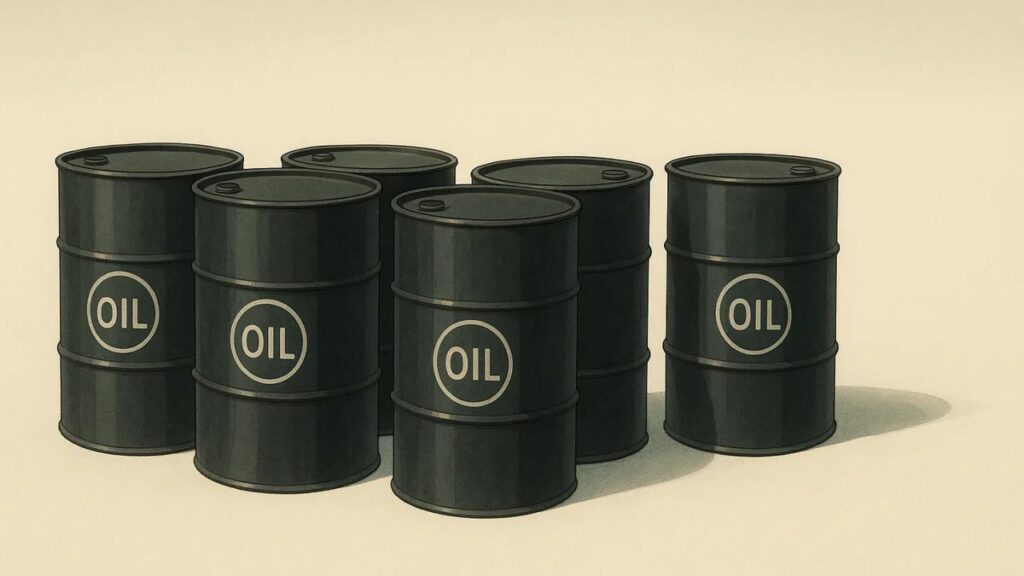
In practical conversion, the figure of 159 liters per barrel is a rounding off of the value of 158.987 liters, which is often used in technical and economic calculations of the oil industry. It is a very important benchmark for calculating the volume of oil produced, transmitted, or stored by oil companies around the world.
On an industrial scale, these volume measurements play an important role in determining the operational, transportation, and storage costs of oil, which directly affect the selling and buying prices of oil in the global market.
The use of barrels is also the basis for calculating oil prices and production metrics such as “barrels per day” (bpd), which measures the amount of oil produced each day by a particular well or country.
This measurement system is essential for analyzing global oil production levels and for predicting future oil supply. In international trade, this barrel-based measurement provides transparency in global transactions, allowing oil trade to take place efficiently and understandably for all parties involved.
Also read: Silver Price Prediction 2026: Could it Reach $309 per Ounce?
What it Means for Energy Users and Investors
For energy consumers, the knowledge that 1 barrel = 159 liters helps in understanding the price and usage of fuels at a global level. Often, the price of fuels, such as gasoline and diesel, is calculated based on barrel volume, which is then converted to a price per liter for the local market.
In addition, for investors and energy market analysts, the barrel is a reference for estimating potential oil reserves, production volumes, and future oil price projections.
This consistent conversion is also very useful in making investment decisions, as it allows direct comparison between different oil-producing countries or different oil companies. The use of barrels in market analysis helps investors to gauge risks and opportunities in the energy sector.
Conclusion
The barrel unit remains an important measure in the oil industry despite evolving technologies and transportation methods. With a standard of 1 barrel ≈ 159 liters, this measure has been maintained to maintain consistency in the global oil trade.
The use of barrels as the standard unit in trading and reporting oil production ensures transparency and uniformity in the international petroleum industry, providing a solid basis for all market participants to conduct efficient and accountable transactions.
CVXon: Chevron Stock Assets in a Blockchain World
As blockchain technology develops, it is now possible to own shares of large companies in digital form through tokenized assets.
CVXon is a tokenized asset that represents shares of Chevron oil company (CVX). Each CVXon token is secured by physical shares of Chevron that are held in reputable depository institutions and closely monitored by international financial authorities. With CVXon, investors can have exposure to Chevron shares directly through the blockchain, allowing them to invest with the flexibility and transparency offered by digital technology.
CVXon tokens are available and traded on various crypto exchanges, providing an attractive investment alternative for those looking to participate in the Chevron stock market without having to deal with traditional processes.
Follow us on Google News to stay up to date with the latest in crypto and blockchain technology. Check Bitcoin price, usdt to idr and tokenized nvidia stock price via Pintu Market.
Enjoy an easy and secure crypto trading and crypto gold investment experience by downloading the Pintu crypto app via Play Store or App Store now. Also, experience web trading with advanced trading tools such as pro charting, various order types, and portfolio tracker only at Pintu Pro.
*Disclaimer
This content aims to enrich readers’ information. Pintu collects this information from various relevant sources and is not influenced by outside parties. Note that an asset’s past performance does not determine its projected future performance. Crypto trading activities are subject to high risk and volatility, always do your own research and use cold hard cash before investing. All activities of buying and selling Bitcoin and other crypto asset investments are the responsibility of the reader.
Reference:
- PGN LNG. Definition, Size, and Function of Barrels in the Oil Industry. Accessed March 15, 2026
- IDX Channel. 1 Barrel How Many Liters?Let’s see the explanation. Accessed on March 15, 2026
- Industrial Solar. Getting acquainted with barrels in the petroleum industry. Accessed March 15, 2026
- Featured Image: Generated by AI
Latest News
© 2026 PT Pintu Kemana Saja. All Rights Reserved.
The trading of crypto assets is carried out by PT Pintu Kemana Saja, a licensed and regulated Digital Financial Asset Trader supervised by the Financial Services Authority (OJK), and a member of PT Central Finansial X (CFX) and PT Kliring Komoditi Indonesia (KKI). Crypto asset trading is a high-risk activity. PT Pintu Kemana Saja do not provide any investment and/or crypto asset product recommendations. Users are responsible for thoroughly understanding all aspects related to crypto asset trading (including associated risks) and the use of the application. All decisions related to crypto asset and/or crypto asset futures contract trading are made independently by the user.